As an experienced dash cam technician with a decade in the field, I’ve witnessed firsthand the dramatic evolution of in-vehicle recording technology. From rudimentary early models to today’s sophisticated devices, one component consistently stands as the linchpin of video quality: the image sensor. Among these, Sony’s STARVIS technology has long been a benchmark for exceptional low-light performance. But with the introduction of STARVIS 2, the game has undeniably changed. This comprehensive guide delves into a direct comparison between Sony’s STARVIS 1 and the next-generation STARVIS 2 sensors, revealing the technical breakthroughs and real-world impacts that influence your dash cam’s ability to capture crucial evidence on every journey.
Understanding Sony STARVIS Technology: A Foundation for Clarity
|
Our Picks for the Best Dash Cam in 2026
As an Amazon Associate I earn from qualifying purchases.
|
||
| Num | Product | Action |
|---|---|---|
| 1 | REDTIGER 4K Dash Cam Front Rear, STARVIS 2 Sensor, Free Card Included, 5.8GHz WiFi-20MB/s Fast Download, Dash Camera for Cars with GPS, WDR Night Vision, 170°Wide Angle, 24H Parking Mode(F7NP) |

|
| 2 | WOLFBOX G840S 12" 4K Mirror Dash Cam Backup Camera, 5.8GHz WiFi Smart Rearview Mirror for Cars & Trucks, Front and Rear View Dual Cameras, Night Vision, Parking Assistance, Included 32GB Card & GPS |
|
| 3 | Dash Cam Front and Rear, 2.5K Dual Dash Camera for Cars, 2560P Mini Car Camera, 2 inch IPS Screen, 32GB Card Included, WDR Night Vision, 24 Hours Parking Monitor, G-Sensor, Support 256 GB Max |
|
| 4 | 4K Dash Cam Front, Built-in 5G WiFi, 64GB Card Included, Dash Camera for Cars, Mini Dashcam with Super Night Vision, Loop Recording, G-Sensor, 24 Hours Parking Monitor, Support 256GB Max |
|
| 5 | VIOFO A229 Plus Dash Cam Front and Rear, Dual STARVIS 2 Sensors, 2 Channel HDR, 1440P+1440P Voice Control Car Dash Camera, 5GHz Wi-Fi, Voice Control, Ultra-Precise GPS |
|
| 6 | Dual 4K Dash Cam Front and Rear - Free 64G SD Card, 2160P+2160P UHD Dash Camera for Cars, Dashcam with 176°+160° Wide Angle, 3.5'' IPS Screen Dashcam, G-Sensor, WDR, Night Vision, 24H Parking Monitor |
|
| 7 | ROVE R2-4K DUAL Dash Cam Front and Rear, STARVIS 2 Sensor, FREE 128GB Card Included, 5G WiFi - up to 20MB/s Fastest Download Speed with App, 4K 2160P/FHD Dash Camera for Cars, 3" IPS, 24H Parking Mode |
|
| 8 | 4K+4K Dash Cam Front and Rear, Free 128GB Card Included, 5.8GHz WiFi Dash Camera for Cars, Built-in GPS, G-Sensor, 170°Wide Angle, 3" IPS Screen, 24H Parking Mode, Support 512GB Max |
|
| 9 | Garmin Dash Cam™ Mini 3, Ultracompact 1080p HD Dash Cam with a 140-degree Field of View, Built in Clarity™ Polarizer, Voice Controlled, Automatic Recording |
|
| 10 | Dash Cam Front and Rear, 1080P Dash Camera for Cars, 3 Channel Car Camera Front Rear and Inside with 32GB Card, Loop Recording, Night Vision, HDR, 24Hr Parking, G-Sensor |
|
Before we dissect the differences, it’s essential to appreciate the innovation that STARVIS 1 brought to the table. Introduced by Sony, STARVIS (an acronym for “Starlight Visibility”) is a back-illuminated pixel technology designed specifically for CMOS image sensors. Its primary goal was to achieve significantly higher sensitivity in low-light and near-infrared conditions, a critical requirement for surveillance and, by extension, dash cam applications. This design places the photodiode above the wiring layer, minimizing light loss and allowing more photons to be captured.
First-generation STARVIS sensors became the gold standard for dash cams, transforming night vision from grainy, often indistinguishable footage into usable, clearer video. They delivered impressive image quality even in dimly lit environments, allowing for better identification of objects and events after dark. Features like HDR (High Dynamic Range) were also integrated into many STARVIS 1 implementations, helping to balance scenes with extreme light and shadow, though with certain limitations we’ll explore shortly.
The Next Evolution: Introducing Sony STARVIS 2
The world of automotive safety and surveillance demands constant innovation. While STARVIS 1 was groundbreaking, challenges remained, particularly in extremely dark scenarios, high-contrast lighting, and with minimizing motion artifacts. Recognizing these needs, Sony engineered STARVIS 2, an advanced iteration designed to push the boundaries of low-light sensitivity and dynamic range even further. This next-generation technology aims to deliver even more reliable and detailed video evidence, ensuring drivers have the clearest possible record of events, regardless of ambient light conditions.
Head-to-Head: Sony STARVIS 2’s Technological Edge Over STARVIS 1
The leap from STARVIS 1 to STARVIS 2 isn’t merely incremental; it represents significant architectural and processing enhancements. These improvements directly translate into superior image quality, especially in the demanding and rapidly changing environments dash cams operate in.
Unparalleled Low-Light Sensitivity: Quantifying the Difference
STARVIS 2 boasts a profoundly refined back-illuminated structure and optimized pixel design, enabling it to capture significantly more light than its predecessor. In extremely dark environments, STARVIS 2 exhibits an approximate 4.6 times improvement in light-gathering ability compared to STARVIS 1 [cite: 1 (search 4)]. This means that where STARVIS 1 might produce degraded, noisy, and practically useless footage, STARVIS 2 sensors, such as the IMX678 or IMX675, can still capture clear images even under illumination as low as 0.009 lux – a level comparable to deep twilight or moonlight [cite: 1 (search 4); 3 (search 2)]. This enhanced sensitivity translates to brighter, more detailed night-time recordings, crucial for identifying vehicle types, road signs, and even facial features in challenging conditions.
Revolutionary High Dynamic Range (HDR) with Clear HDR: Eliminating Motion Artifacts
One of the most critical advancements in STARVIS 2 is its approach to HDR. Traditional HDR implementations, often seen with STARVIS 1, use a technique called Digital Overlap HDR (DOL-HDR), where multiple exposures (typically a short exposure for bright areas and a long exposure for dark areas) are captured sequentially and then merged. While effective for static scenes, this sequential capture can lead to “motion artifacts” like ghosting or color fringing when subjects are moving rapidly, such as passing vehicles or pedestrians [cite: 5 (search 1); 1 (search 4)].
STARVIS 2 introduces Clear HDR, a revolutionary method that applies gain before capture and then acquires two images at different exposures simultaneously [cite: 3 (search 4)]. This simultaneous capture fundamentally eliminates the time-shift artifacts that plagued earlier HDR systems, resulting in clean, blur-free footage even with fast-moving targets in high-contrast environments. Furthermore, STARVIS 2 achieves a significantly wider dynamic range, approximately 2.5 times that of STARVIS 1, reaching up to 78 dB in a single exposure [cite: 1 (search 4)]. This expanded range ensures that details in both the brightest highlights and deepest shadows are preserved, providing a more balanced and informative video.
Enhanced Near-Infrared (NIR) Performance: Seeing in Absolute Darkness
Dash cams, especially those used for interior recording or advanced parking surveillance, often rely on near-infrared (NIR) light for visibility in complete darkness. STARVIS 2 incorporates irregular structures on the photodiode’s incident plane to refract and absorb NIR light more effectively. This proprietary design results in an NIR sensitivity approximately 2.5 times greater than STARVIS 1 [cite: 3 (search 1); 1 (search 4)]. For situations where IR illuminators are used, such as cabin cameras in rideshare vehicles or parking mode in unlit garages, STARVIS 2 provides vastly improved visibility, allowing for clearer recording of occupants or potential intruders without the need for visible light.
Superior Detail and Noise Reduction: Sharpening the Evidence
The combination of larger pixel size, improved light concentration, and advanced internal processing in STARVIS 2 leads to a noticeable increase in overall resolution and clarity. Footage from STARVIS 2 dash cams allows for easier identification of critical details like license plate numbers, road signs, and even intricate scene elements, which can be pivotal in accident reconstruction or insurance claims [cite: 1 (search 1); 2 (search 2)]. Moreover, sophisticated noise reduction technologies integrated into STARVIS 2 sensors yield cleaner images with less grain, particularly in challenging lighting conditions, further enhancing the evidentiary value of your recordings [cite: 1 (search 1)].
Optimized Power Efficiency: A Greener, Cooler Operation
Energy consumption is a practical concern for any electronic device, especially those operating continuously in a vehicle. STARVIS 2 utilizes a stacked sensor structure with advanced Cu-Cu connections between pixel and circuit layers. This architectural optimization shortens signal paths, leading to reduced energy loss. Tests indicate that STARVIS 2 can achieve approximately 30% lower power consumption compared to STARVIS 1 [cite: 1 (search 4)]. This efficiency not only contributes to a greener operation but also reduces heat buildup within the dash cam, potentially extending the device’s lifespan and improving overall stability, particularly in hot climates or during prolonged parking surveillance.
> “The difference in high-contrast scenes, especially with motion, is where STARVIS 2 truly shines. Eliminating motion artifacts means undeniable evidence, which is priceless for drivers.” – Admin, Dashcamon.com
Real-World Impact: What These Sensors Mean for Your Dash Cam Footage
The technological enhancements of STARVIS 2 translate directly into tangible improvements for real-world dash cam usage.
Night Driving: From Grainy to Pristine
Imagine driving on a poorly lit road at night. With a STARVIS 1 dash cam, you might get a general sense of your surroundings, but license plates of passing cars could be blurry, and distant objects indistinct. A STARVIS 2 dash cam, however, captures significantly more light, resulting in brighter, clearer footage where details are far more discernible. This dramatically improves the chances of identifying vehicles involved in hit-and-runs or other incidents after dark.
Challenging Light Conditions: Balancing Bright and Dark
Consider exiting a dark tunnel into bright daylight, or driving towards a sunset with strong glare and deep shadows. These high-contrast scenarios are notorious for causing issues with older sensors, often leading to overexposed skies and underexposed foregrounds. STARVIS 2’s superior HDR with Clear HDR handles these transitions with remarkable efficacy, maintaining detail in both the brightest and darkest parts of the frame. This means you won’t lose critical information to blown-out highlights or murky shadows.
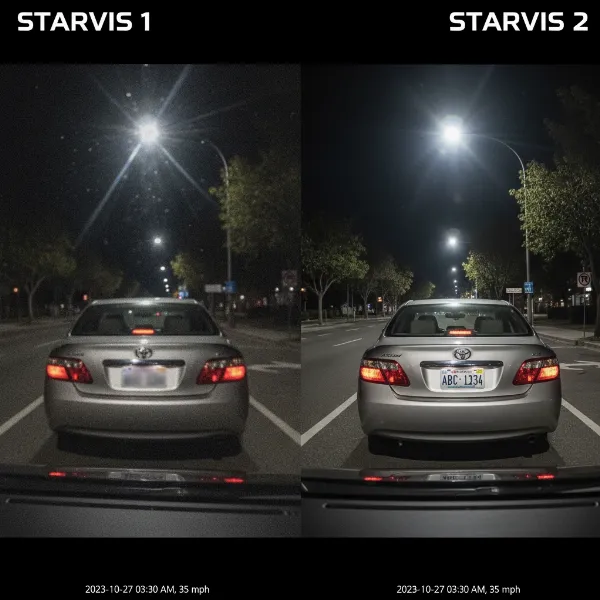 Dash Cam footage comparing Sony STARVIS 1 vs STARVIS 2 at night, showing clearer details and less noise.
Capturing Critical Details: License Plates and Fast Motion
The ability to accurately record license plates is paramount for any dash cam. With STARVIS 1’s DOL-HDR, fast-moving vehicles could appear with noticeable blur or color shifts, rendering their plates unreadable. STARVIS 2’s simultaneous dual-exposure HDR eradicates this issue, ensuring that even a vehicle speeding past your dash cam will have its license plate captured with greater clarity and precision, making it far more useful as evidence [cite: 4 (search 1)].
Extended Parking Surveillance
For drivers who rely on parking mode, a dash cam with a STARVIS 2 sensor offers significant advantages. The enhanced low-light sensitivity means that even in dimly lit parking lots, the camera can capture clearer events. Coupled with improved NIR performance, if your dash cam uses IR illumination, any activity around your parked vehicle will be recorded with superior detail, providing robust security around the clock. The lower power consumption also means longer, more stable surveillance periods without draining your car battery as quickly.
Identifying STARVIS 2 Dash Cams: Models and Recommendations
As the demand for superior dash cam performance grows, more manufacturers are integrating Sony STARVIS 2 sensors into their premium models. Key sensor models to look for include the Sony IMX678 (often found in 4K dash cams), IMX675 (for 2K/QHD applications), and IMX662 (for Full HD 1080p recording, sometimes marketed as a budget-friendly STARVIS 2 option) [cite: 1 (search 3)].
Several reputable dash cam brands are leading the charge with STARVIS 2 integration. VIOFO offers a wide range of models featuring these sensors, including the A119 Mini 2, A229 Plus, A229 Pro, A329S, A329T, A229 Ultra, and A119M Pro [cite: 4 (search 3)]. Vantrue has also adopted STARVIS 2 in models like the E360, Sonnet 1 Pro (S1 Pro), and Nexus 4 Pro (N4 Pro) [cite: 2 (search 3)]. Even brands like 70mai have introduced STARVIS 2 into their lineup with models like the A810, A510, and M200 [cite: 5 (search 3)]. When making a purchase, always verify the specific sensor model used, as sensor quality, rather than just resolution, dictates actual video performance [cite: 4 (search 1)].
Making the Upgrade: Is a STARVIS 2 Dash Cam Right for You?
For many drivers, especially those who frequently drive at night, regularly encounter challenging lighting, or prioritize the highest possible evidentiary quality from their dash cam, upgrading to a model with a Sony STARVIS 2 sensor is a highly worthwhile investment.
If your current dash cam uses an older sensor, or even a first-generation STARVIS sensor, and you find yourself struggling with blurry license plates at night, poor detail in shadows, or washed-out highlights, a STARVIS 2 dash cam will offer a dramatic improvement. For rideshare drivers, fleet managers, or anyone for whom clear, reliable footage is a non-negotiable safety and security asset, the technological advantages of STARVIS 2 make it the undisputed choice. While these advanced models may come at a slightly higher price point, the enhanced peace of mind and the superior quality of captured evidence often justify the cost.
Conclusion
The evolution from Sony STARVIS 1 to STARVIS 2 represents a significant leap forward in dash cam technology, redefining what’s possible in terms of video clarity, low-light performance, and dynamic range. With its unparalleled sensitivity, revolutionary Clear HDR, enhanced NIR capabilities, and improved power efficiency, STARVIS 2 sensors deliver footage that is brighter, sharper, and more reliable than ever before. For anyone serious about road safety and securing irrefutable evidence, understanding these sensor differences is key to making an informed choice. Upgrading to a dash cam equipped with a STARVIS 2 sensor isn’t just about buying a new gadget; it’s about investing in a superior level of protection and clarity on every journey. What advancements in dash cam technology are you most excited to see next?
Frequently Asked Questions
What are the main benefits of STARVIS 2 over STARVIS 1 for dash cams?
STARVIS 2 offers significantly improved low-light sensitivity (up to 4.6x better in extreme darkness), a revolutionary Clear HDR that eliminates motion artifacts, 2.5 times higher Near-Infrared (NIR) sensitivity, superior detail, reduced noise, and approximately 30% lower power consumption compared to STARVIS 1.
Can I upgrade the sensor in my existing dash cam to STARVIS 2?
No, the image sensor is an integrated component of your dash cam and cannot be upgraded. To benefit from STARVIS 2 technology, you would need to purchase a new dash cam that is specifically equipped with a STARVIS 2 sensor.
Does a higher resolution (e.g., 4K) always mean better video quality, even with older sensors?
Not necessarily. While resolution is important, the quality of the image sensor is often more critical for real-world video performance, especially in challenging conditions like low light. A 2K dash cam with a high-quality STARVIS 2 sensor can often outperform a budget 4K dash cam with an inferior or older sensor, particularly at night.
What are some popular dash cam models that use Sony STARVIS 2 sensors?
Several brands, including VIOFO (e.g., A119 Mini 2, A229 Pro), Vantrue (e.g., E360, Nexus 4 Pro), and 70mai (e.g., A810), offer Dash Cams equipped with Sony STARVIS 2 sensors like the IMX678, IMX675, and IMX662.