Driving today often means navigating unpredictable roads, and for many, a dash cam has become an indispensable guardian, silently recording every moment of your journey. These devices offer invaluable peace of mind, acting as an unbiased witness in case of an accident, deterring theft, or even capturing unexpected events. However, before you affix that dash cam to your windshield, there’s a crucial question to answer: is it legal? The answer, like many things in the United States, isn’t a simple yes or no, but rather a patchwork of state-specific regulations governing placement, visibility, and even audio recording. Understanding these nuances is key to staying compliant and ensuring your dash cam footage remains admissible if you ever need it.
The Legality of Dash Cams: A General Overview
The good news for drivers is that dash cams themselves are legal in all 50 U.S. states and the District of Columbia. You won’t find any state law explicitly banning the use of a dash cam in your vehicle. The challenge, and where state laws begin to diverge significantly, lies not in having a dash cam, but in where and how you mount it within your vehicle, particularly on the windshield. Many states have existing laws designed to prevent any object from obstructing a driver’s clear view of the road, and dash cams can easily fall under these regulations if not placed correctly.
Understanding Windshield Obstruction Laws
The core principle behind most state laws concerning dash cam placement is the prohibition of windshield obstruction. These laws are in place for a vital reason: to ensure drivers have an unimpeded view of the road, traffic, pedestrians, and potential hazards. Any object, including a dash cam, that blocks a driver’s line of sight can create a dangerous blind spot, increase the risk of accidents, and lead to legal repercussions. Ignoring these laws can result in fines, traffic citations, and, crucially, may render your dash cam footage inadmissible in court if it was obtained in violation of state statutes.
Three Main Approaches to Windshield Mounting Laws by State
While the general rule is to avoid obstruction, states adopt different strategies to regulate dash cam placement. These can broadly be categorized into three types:
1. States with Explicit Placement Zones
Some states provide clear, specific guidelines on where devices, including dash cams, can be mounted on the windshield. These zones are typically small, designated areas that are considered least likely to obstruct the driver’s view.
- California: Allows dash cams to be mounted in a 7-inch square in the lower corner of the windshield farthest removed from the driver, or a 5-inch square in the lower corner nearest the driver. Notably, California law also specifies that video event recorders do not have to comply with general windshield obstruction laws, providing an explicit exemption for these devices when correctly placed.
- Nevada: Similar to California, permits dash cam installation in the lower corner of the windshield farthest from the driver.
- Vermont: Allows devices to be mounted in a 5-inch square in the lower corner of the windshield farthest removed from the driver.
In these states, compliance means adhering strictly to the specified dimensions and locations.
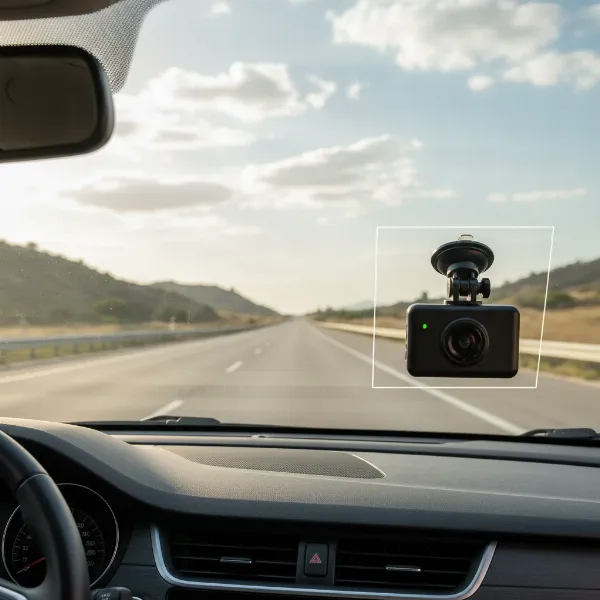 Dash cam mounted legally in specified windshield zone for clear driver view.
2. States with Strict or Near-Ban on Windshield Devices
A handful of states take a more restrictive approach, generally prohibiting any non-transparent objects on the front windshield or even side windows.
- New Jersey: Has a rule that does not allow drivers to have any non-transparent objects on the front windshield or on either the driver or passenger side window.
- New Hampshire: Explicitly prohibits drivers from placing a front-facing dash cam on their car windshield.
- Minnesota and Pennsylvania: Also tend to have very restrictive laws concerning objects that may obstruct a driver’s view through the windshield.
In these jurisdictions, mounting a dash cam on the dashboard or behind the rearview mirror is often the only legal and safe alternative.
3. States with a General Obstruction Standard
The majority of U.S. states fall into this category. They don’t specify precise mounting zones or issue outright bans but instead enforce a general “don’t block the driver’s view” standard. In these states, the legality often comes down to discretion and whether the device is deemed to impede the driver’s clear line of sight.
- Alabama: While dash cams are legal, suction-mounted devices on the windshield are generally considered an obstruction. Mounting on the dashboard is legal.
- Alaska: Allows dash cams as long as they don’t obstruct the driver’s view and are smaller than 5 or 7 inches on one side, depending on the mounting location.
- Arizona: Prohibits objects or materials on the windshield that obstruct a driver’s clear view, allowing devices no larger than 5×5 inches on the left or 7×7 inches on the right.
- Colorado: Prohibits driving with non-transparent or reflective material that obstructs the driver’s view. Mounting behind the rearview mirror or on the dashboard is recommended.
- Connecticut: It is illegal to have an opaque object on the windshield; therefore, dashboard mounting is typically required.
For states under a general obstruction standard, common sense and a commitment to maintaining an unimpeded view are your best guides. A small, discreet dash cam placed inconspicuously is usually acceptable.
Optimal Dash Cam Placement for Compliance
Given the varying state laws, where is the safest and most compliant place to mount your dash cam?
- Behind the Rearview Mirror: This is widely considered one of the best locations in most states. The rearview mirror already occupies a central space, and a compact dash cam discreetly mounted behind it can record the road ahead without significantly obstructing the driver’s view.
- On the Dashboard: For states with strict windshield obstruction laws or those with a general “no obstruction” rule, placing the dash cam on the dashboard can be a viable alternative. Ensure it is stable, does not slide around, and still does not rise to a height that would block your view.
- Lower Corners of the Windshield (if permitted): In states like California, specific lower corner zones are allowed. Always refer to your state’s particular dimensions and locations.
Regardless of the mounting point, always double-check that the dash cam does not interfere with the deployment path of airbags, and that all cables are routed safely to avoid distraction or entanglement.
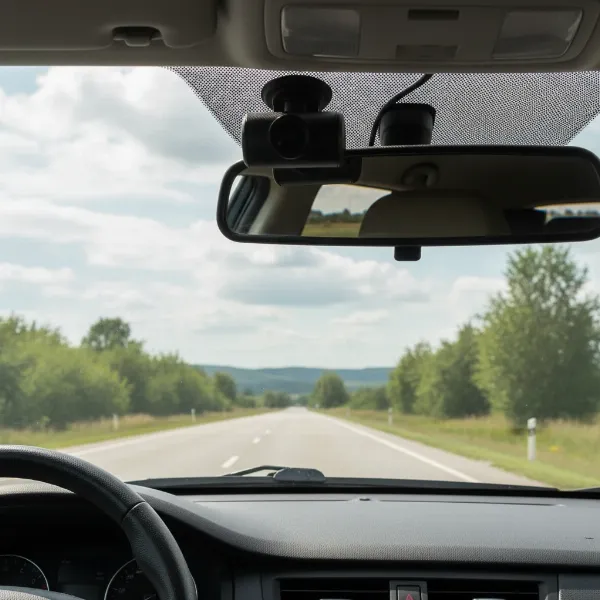 Optimal dash cam placement behind the rearview mirror for unobscured visibility.
Beyond Windshield Placement: Audio Recording Laws
While physical placement is critical, the act of recording audio with your dash cam introduces another layer of legal complexity. Privacy laws regarding audio recording vary significantly by state:
- All-Party Consent States: Approximately 11 states require “all-party consent,” meaning every person being recorded in a private conversation must give their permission. If your dash cam records audio inside the vehicle, you must inform passengers and obtain their consent. States like California, Connecticut, Delaware, Florida, Illinois, Maryland, Massachusetts, Montana, New Hampshire, Pennsylvania, and Washington typically fall into this category for private conversations.
- Single-Party Consent States: The majority of states are “single-party consent” states, where only one person involved in the conversation needs to consent to the recording. As the driver, your consent is usually sufficient.
To avoid potential legal issues, especially if you frequently travel between states, it’s generally best practice to inform passengers that audio is being recorded, or simply disable the audio recording function on your dash cam.
Dash Cam Footage as Legal Evidence
The primary purpose of a dash cam is often to provide irrefutable evidence in legal situations. For footage to be admissible in court, several factors are crucial:
- Legally Obtained: The footage must have been recorded in compliance with all applicable state laws regarding placement, privacy, and audio recording. Illegally obtained evidence may be inadmissible.
- Authenticity: Courts typically require footage to have intact timestamps and GPS data to prove its authenticity. Tampering with or editing clips after an incident can be considered obstruction of justice and may invalidate the evidence.
- Chain of Custody: Maintaining a clear chain of custody for the footage, often through automated cloud backups or secure storage, helps demonstrate that the evidence has not been altered.
“Dash cam technology offers undeniable benefits for driver safety and legal protection. However, the legal landscape for their use is dynamic. Drivers must commit to understanding and adhering to their state’s specific mounting and recording laws to truly leverage their dash cam’s potential.” – Admin, Dashcamon.com, Dash Cam Expert with 10+ Years Experience
Navigating Interstate Travel with Your Dash Cam
If you plan on driving across state lines with your dash cam, the safest approach is to adopt the strictest state rule along your route. This minimizes the risk of inadvertently violating a law as you travel from one jurisdiction to another. A low-profile dash cam mounted discreetly behind the rearview mirror or on the dashboard, with audio recording disabled, offers the highest degree of compliance and peace of mind.
Key Considerations When Choosing and Using Your Dash Cam
- Research Local Laws: Before purchasing and installing a dash cam, dedicate time to researching your specific state’s laws regarding windshield obstruction and audio recording. Laws can change, so stay updated.
- Select a Discreet Model: Opt for a compact, low-profile dash cam that can be easily hidden or placed inconspicuously, reducing the likelihood of it being deemed an obstruction.
- Regularly Check Mounting: Ensure your dash cam is securely mounted and has not shifted into a position that obstructs your view.
- Consider Professional Installation: For optimal placement and wiring, a professional installation can ensure your dash cam is legally positioned and functions correctly without impeding your driving.
Conclusion
The question of whether it’s legal to mount a dash cam on your windshield is complex, directly tied to individual state laws and the specifics of device placement. While dash cams are universally legal to own and operate, their mounting is subject to strict visibility regulations designed to keep roads safe. By understanding the distinctions between states with explicit placement zones, strict bans, or general obstruction standards, and by adhering to best practices like discreet mounting behind the rearview mirror or on the dashboard, you can confidently utilize your dash cam. Always remember to consider audio recording consent and the criteria for footage admissibility to fully protect yourself. What steps will you take to ensure your dash cam is legally positioned for your next drive?
Frequently Asked Questions
Are dash cams legal everywhere in the U.S.?
Yes, dash cams are legal in all 50 U.S. states and the District of Columbia. The legality concerns arise primarily from how and where the dash cam is mounted in your vehicle, especially on the windshield, and whether it records audio.
Can I mount my dash cam anywhere on the windshield?
No, you cannot mount your dash cam anywhere on the windshield. Most states have laws prohibiting windshield obstruction, meaning objects cannot block the driver’s clear view. Some states allow mounting only in small, specific zones, while others have near-total bans on windshield-mounted devices.
What about recording audio with my dash cam?
Audio recording laws vary by state. Approximately 11 states require “all-party consent” for private conversations, meaning everyone in the vehicle must agree to be recorded. Other states only require “single-party consent.” It’s advisable to inform passengers or disable audio recording if you’re unsure of your state’s laws or if you travel across state lines.
What are the consequences of mounting a dash cam illegally?
Illegally mounting a Dash Cam can lead to traffic citations, fines, and potentially invalidate any footage you record if it’s deemed to be obtained in violation of state laws. It can also create dangerous blind spots, compromising driving safety.