Dash cams have become indispensable tools for drivers, offering peace of mind and crucial evidence in unforeseen road incidents. These devices typically capture high-definition video of the road ahead, but many modern dash cams also feature built-in microphones, allowing them to record audio inside the vehicle. This added capability brings a layer of complexity, intertwining convenience with significant privacy considerations. Before you rely on your dash cam to capture every sound, it’s vital to understand the varying privacy laws that govern audio recording inside a vehicle. Failing to do so could turn a helpful piece of technology into a legal liability. This comprehensive guide will navigate the intricate legal landscape of in-car audio recording, helping you understand your rights and responsibilities.
The Unseen Recorder: Dash Cams and In-Car Audio
|
Our Picks for the Best Dash Cam in 2026
As an Amazon Associate I earn from qualifying purchases.
|
||
| Num | Product | Action |
|---|---|---|
| 1 | Garmin Dash Cam™ Mini 3, Ultracompact 1080p HD Dash Cam with a 140-degree Field of View, Built in Clarity™ Polarizer, Voice Controlled, Automatic Recording |

|
| 2 | Dual 4K Dash Cam Front and Rear - Free 64G SD Card, 2160P+2160P UHD Dash Camera for Cars, Dashcam with 176°+160° Wide Angle, 3.5'' IPS Screen Dashcam, G-Sensor, WDR, Night Vision, 24H Parking Monitor |
|
| 3 | Dash Cam Front and Rear, 1080P Dash Camera for Cars, 3 Channel Car Camera Front Rear and Inside with 32GB Card, Loop Recording, Night Vision, HDR, 24Hr Parking, G-Sensor |
|
| 4 | 4K+4K Dash Cam Front and Rear, Free 128GB Card Included, 5.8GHz WiFi Dash Camera for Cars, Built-in GPS, G-Sensor, 170°Wide Angle, 3" IPS Screen, 24H Parking Mode, Support 512GB Max |
|
| 5 | REDTIGER 4K Dash Cam Front Rear, STARVIS 2 Sensor, Free Card Included, 5.8GHz WiFi-20MB/s Fast Download, Dash Camera for Cars with GPS, WDR Night Vision, 170°Wide Angle, 24H Parking Mode(F7NP) |
|
| 6 | ROVE R2-4K DUAL Dash Cam Front and Rear, STARVIS 2 Sensor, FREE 128GB Card Included, 5G WiFi - up to 20MB/s Fastest Download Speed with App, 4K 2160P/FHD Dash Camera for Cars, 3" IPS, 24H Parking Mode |
|
| 7 | 4K Dash Cam Front, Built-in 5G WiFi, 64GB Card Included, Dash Camera for Cars, Mini Dashcam with Super Night Vision, Loop Recording, G-Sensor, 24 Hours Parking Monitor, Support 256GB Max |
|
| 8 | WOLFBOX G840S 12" 4K Mirror Dash Cam Backup Camera, 5.8GHz WiFi Smart Rearview Mirror for Cars & Trucks, Front and Rear View Dual Cameras, Night Vision, Parking Assistance, Included 32GB Card & GPS |
|
| 9 | VIOFO A229 Plus Dash Cam Front and Rear, Dual STARVIS 2 Sensors, 2 Channel HDR, 1440P+1440P Voice Control Car Dash Camera, 5GHz Wi-Fi, Voice Control, Ultra-Precise GPS |
|
| 10 | Dash Cam Front and Rear, 2.5K Dual Dash Camera for Cars, 2560P Mini Car Camera, 2 inch IPS Screen, 32GB Card Included, WDR Night Vision, 24 Hours Parking Monitor, G-Sensor, Support 256 GB Max |
|
Many drivers might not even realize their dash cam is capable of, or actively recording, audio from within the car. While the primary function of a dash cam is visual documentation of events on the road, the microphone feature offers additional context. Imagine an accident scenario: an audio recording could capture critical conversations with other drivers, witness statements, or even sounds within your vehicle that shed light on the circumstances leading to the collision, such as a sudden distraction or brake screeching. For fleet managers or rideshare operators, in-car audio can be used for driver monitoring, ensuring compliance with company policies and offering an extra layer of protection against false claims.
However, these benefits are balanced by significant privacy concerns. Passengers may feel uncomfortable, or even violated, if their conversations are recorded without their knowledge. Personal or sensitive information could inadvertently be captured, leading to breaches of confidentiality and an overall invasion of privacy. This tension between utility and privacy is precisely why legal frameworks exist to regulate audio recording.
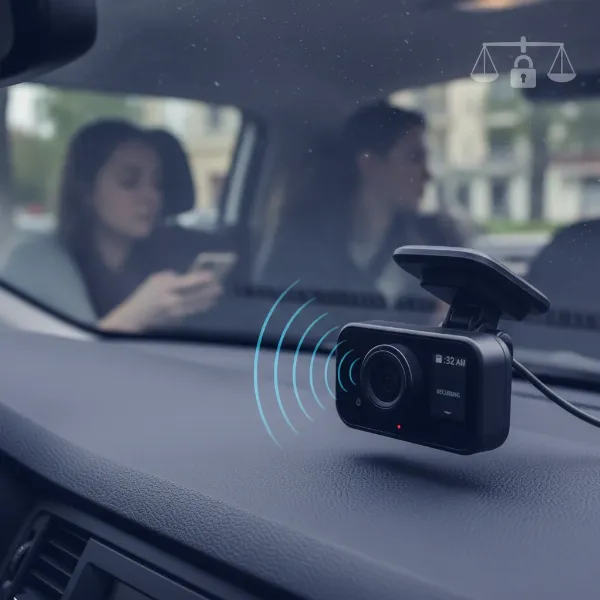 A dash cam recording audio inside a car, highlighting privacy concerns with sound waves and blurred passengers.
Navigating the Legal Landscape: One-Party vs. All-Party Consent
The legality of recording audio inside your car is not uniform across all jurisdictions; it largely depends on whether your state operates under a “one-party consent” or an “all-party consent” law. These classifications dictate who must agree to a conversation being recorded for it to be legal.
One-Party Consent States
In states with one-party consent laws, only one individual involved in a conversation needs to grant permission for it to be legally recorded. Crucially, if you are the one doing the recording and you are also a participant in the conversation, your consent is sufficient. This means you generally do not need to inform or seek permission from other parties in the vehicle if you are part of the discussion.
Examples of states that typically follow one-party consent laws for in-person conversations include:
- Arizona
- District of Columbia
- Georgia
- Maine
- New York
- Texas
If you reside in or are driving through a one-party consent state and are actively participating in a conversation, your dash cam’s audio recording would likely be considered legal.
All-Party (or Two-Party) Consent States
Conversely, all-party consent states require every single person involved in a conversation to provide their consent before it can be legally recorded. This significantly changes the requirements for dash cam users. If you have passengers in your car in an all-party consent state, you must inform them that audio is being recorded and obtain their explicit permission. Without this, the recording could be deemed illegal, regardless of your intent or whether you are also a participant in the conversation.
Examples of states that typically adhere to all-party consent laws for in-person conversations include:
- California
- Illinois
- Nevada
- Washington
The distinction between these two types of laws is paramount. Misunderstanding or ignoring these regulations can lead to serious legal repercussions, including fines, civil lawsuits, or even criminal charges. It is also important to note that if you are recording a conversation between two other people, and you are not a part of that conversation, you generally cannot legally record it in any state without the consent of at least one of the participants. This situation falls under stricter eavesdropping or wiretapping statutes.
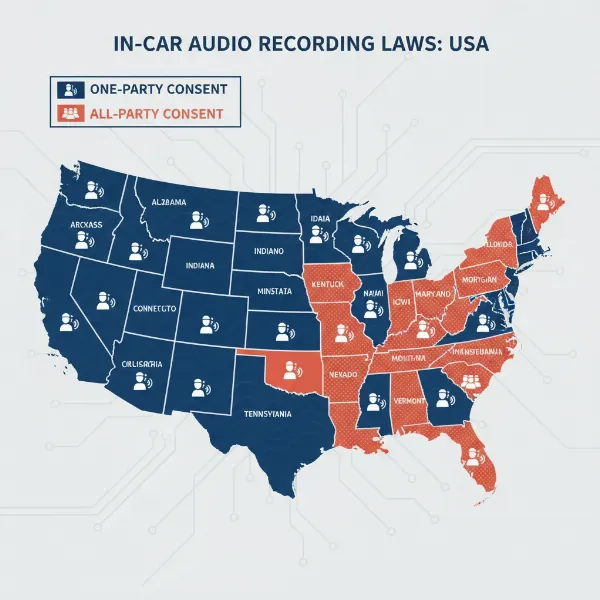 Illustration showing different U.S. states categorized by one-party and all-party consent laws for in-car audio recording.
State-Specific Nuances and Federal Laws
While the one-party vs. all-party distinction forms the backbone of audio recording laws, there can be further nuances within state statutes. Some states may have specific regulations for recordings made in public spaces versus private settings, or different rules for video-only versus audio-and-video recordings. Generally, video recording in public places where there’s no reasonable expectation of privacy (like the open road) is permissible. However, audio recording almost always carries higher legal scrutiny.
Federal law, specifically Title III of the Omnibus Crime Control and Safe Streets Act of 1968, establishes a one-party consent rule for interstate and international communications. However, for in-person conversations like those inside a car, state laws often take precedence, meaning you must abide by the stricter of the federal or state laws that apply. This patchwork of regulations means that drivers must exercise caution and conduct due diligence to understand the specific laws of their operating state and any states they may travel through.
Beyond Your Personal Vehicle: Rideshare, Fleet Cars, and Sharing Recordings
The legal and ethical considerations of in-car audio recording become even more complex in commercial or shared vehicle settings.
Rideshare and Taxi Drivers
For rideshare or taxi drivers, the privacy expectations of passengers are generally higher. While a dash cam can be a valuable safety tool, recording audio without explicit consent from passengers can lead to significant legal and professional issues. Many rideshare companies have strict policies regarding recording passengers, often requiring prominent signage to inform them or even prohibiting audio recording altogether without explicit opt-in. Transparency is key; it’s often best practice to disable audio recording if consent cannot be clearly obtained, or to use a dash cam that only records video.
Company Vehicles
If you drive a company-owned vehicle, your employer may install dash cams that record both video and audio. In such cases, your right to privacy may be limited by your employment agreement and company policy. Employers typically have a legitimate interest in monitoring driver behavior for safety, liability, and operational efficiency. However, they are usually required to inform employees if such monitoring is taking place. Always review your employment contract and company policies regarding vehicle monitoring.
Sharing Recordings
Even if an audio recording is legally obtained, how you use and share it can also have legal ramifications. Sharing recordings on public platforms like social media can expose individuals to unwanted publicity, potentially leading to defamation lawsuits or privacy complaints, especially if the recording captures sensitive conversations or identifiable individuals without their permission. While sharing recordings with your attorney or insurance provider for legal or claims purposes is generally acceptable, public dissemination requires extreme caution. If you intend to profit from a recording that features other people, you almost certainly need their explicit permission to avoid violating their rights of publicity.
Best Practices for Responsible Dash Cam Audio Use
Given the complex and varied legal landscape, responsible use of dash cam audio recording is paramount.
- Know Your State’s Laws: Before enabling audio recording on your dash cam, thoroughly research and understand the specific consent laws in your state and any states you frequently visit.
- Be Transparent: If you decide to record audio, especially with passengers in your vehicle, it is always best practice to inform them. A simple verbal notification or a visible sign can go a long way in managing privacy expectations and potentially fulfilling consent requirements.
- Consider Disabling Audio: If you are unsure about the legality, prefer to err on the side of caution, or prioritize passenger privacy, consider disabling the audio recording feature on your dash cam. Many devices allow you to turn off the microphone while still recording video.
- Review Before Sharing: Never share dash cam recordings, particularly those with audio, without carefully reviewing the content for sensitive information or private conversations. If the recording is for legal evidence, consult with an attorney on appropriate disclosure.
- Consult Legal Counsel: When in doubt, especially in situations involving potential legal disputes or commercial driving, seek advice from a legal professional.
Conclusion
Dash cams with audio recording capabilities offer compelling advantages, from providing irrefutable evidence in accidents to promoting safer driving habits. However, these benefits are inextricably linked to the intricate web of privacy laws that vary significantly from one state to another. The distinction between one-party and all-party consent laws is critical, dictating whether you can legally record conversations inside your car and who needs to be aware.
As dash cams become more ubiquitous, understanding these privacy laws is not just a recommendation but a necessity. By being transparent with passengers, staying informed about local regulations, and exercising caution when sharing recordings, drivers can harness the full potential of their dash cam while respecting privacy and avoiding legal pitfalls. Ultimately, the power of in-car audio recording comes with the responsibility to use it wisely and legally.
Frequently Asked Questions
Is it illegal to record someone without their consent in my car?
It depends on your state’s laws. In “one-party consent” states, you can record if you are part of the conversation. In “all-party consent” states, everyone involved must consent. If you are not a part of the conversation, it is generally illegal to record it without consent from at least one participant.
What are the consequences of illegal audio recording?
Consequences can range from civil lawsuits for invasion of privacy to criminal charges carrying substantial fines and even jail time, depending on the state and the severity of the offense.
Can I use an illegal audio recording as evidence in court?
In most cases, illegally obtained audio recordings are inadmissible as evidence in court. This means that even if the recording contains information useful to your case, a judge may prohibit its use, rendering it useless for legal proceedings.
Do all dash cams always record audio?
No, while many modern dash cams are equipped with built-in microphones and can record audio, this feature is often optional. Most Dash Cam models allow users to enable or disable audio recording in their settings, giving drivers control over this aspect of their privacy.