The dash cam market has seen remarkable evolution, transforming from simple recording devices into sophisticated guardians for our vehicles. Among the innovators that pushed these boundaries was Owlcam, a brand that promised unparalleled connectivity and 24/7 surveillance. The Owlcam Classic 5.0, a prominent iteration, stood out with its ambitious features. Yet, its story is a cautionary tale of innovation meeting the harsh realities of business and technological dependency. This comprehensive review delves into the Owlcam Classic 5.0’s capabilities, its performance during its prime, and critically, its current viability in 2026.
The Vision and The Downfall: Owlcam’s Turbulent Journey
Launched with significant fanfare, Owlcam aimed to revolutionize car security by integrating 4G LTE connectivity directly into a dash cam. The original Owl Car Cam, and subsequently models like the Classic 5.0, offered a compelling vision: real-time incident uploads to the cloud, live remote viewing, and instant alerts to your smartphone, fundamentally changing how drivers interacted with their vehicle’s security. This innovative approach distinguished Owlcam from its competitors, offering a truly “smart” dash cam experience.
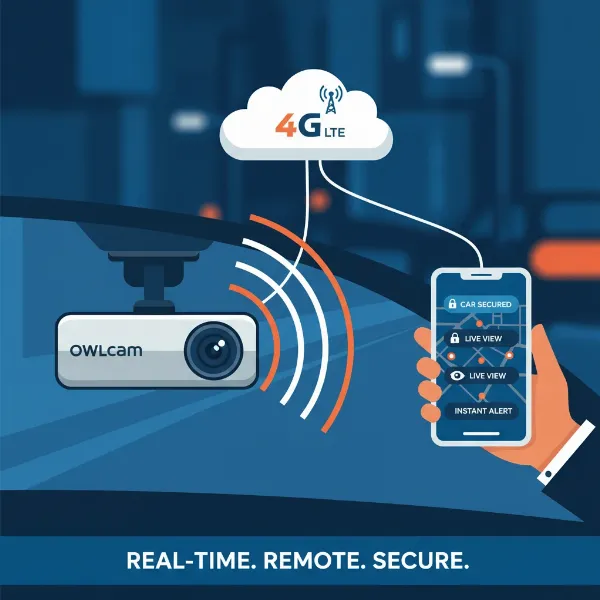 Owlcam dash cam concept showing 4G LTE connectivity, cloud uploads, and smartphone alerts for car security.
However, the operational costs associated with maintaining a robust cellular network and cloud infrastructure proved challenging. In early 2020, the original Owlcam company ceased operations, declaring bankruptcy. This left many early adopters with devices that relied heavily on a now-unsupported service. While Xirgo Technologies later acquired Owlcam’s assets, partnering with CallPass to manage consumer services, the transition was far from smooth, and support for existing consumer devices became inconsistent or ceased entirely. This instability highlighted a critical vulnerability in heavily connected hardware, rendering many units significantly limited, if not entirely inoperable, without active service.
Owlcam Classic 5.0: Features That Defined a Generation
At its core, the Owlcam Classic 5.0 was designed as a comprehensive car security solution. It boasted a dual-camera system, providing simultaneous recording of both the road ahead and the vehicle’s interior. The front-facing camera recorded in 1440p (4MP), while the interior camera captured footage in 720p (1MP), both offering a 120-degree field of view.
Powering the device was a convenient OBD-II port connection, a notable design choice that eliminated the need for separate wiring or concerns about battery drain for parking mode. This allowed the Classic 5.0 to offer 24/7 surveillance, recording events even when the car was parked. Key specifications and features included:
- Dual HD Cameras: Capturing both external and internal views.
- 4G LTE Connectivity: Enabling real-time cloud uploads, remote live view, and instant alerts (during active service).
- OBD-II Power: For constant power and 24/7 parking surveillance without an internal battery.
- Internal Storage: Typically 64GB to 160GB, capable of storing up to 12 hours of continuous driving footage.
- Smart Features: G-sensor for impact detection, GPS for location tracking, “Okay Presto” voice command to save video clips, motion detection, and two-way talk functionality.
- Parking Mode (Guard Mode): Automatic recording upon detected intrusion or impact, with flashing green lights and white LEDs to deter potential threats.
- Temperature Tolerance: Designed to operate between -4°F and 120°F, with an auto-shutdown feature for extreme temperatures.
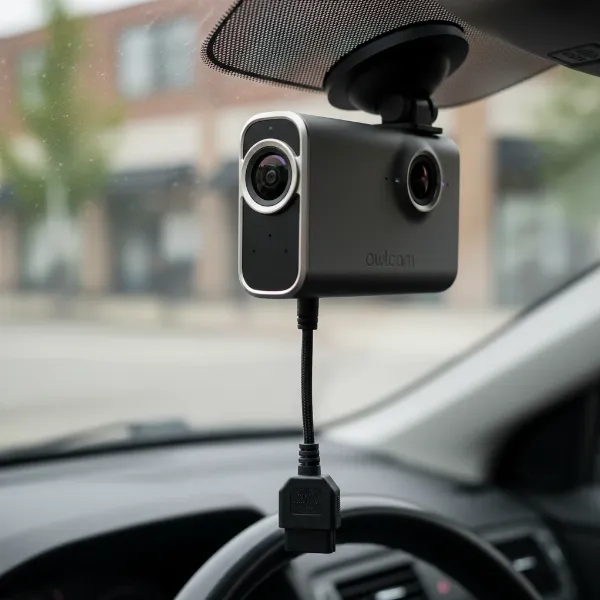 Close-up of Owlcam Classic 5.0 dash cam with dual cameras and visible OBD-II power connection.
Performance Analysis: A Glimpse into its Prime
When its services were fully operational, the Owlcam Classic 5.0 delivered on many of its promises. Its ease of installation and intuitive mobile app were frequently praised, allowing users to quickly set up the device and manage recordings.
- Video Quality: Daytime footage was generally considered good enough for casual and legal use, with decent detail and natural color saturation. However, some reviewers noted it wasn’t the sharpest compared to other premium dash cams. Night vision for exterior recording was commendable in areas illuminated by headlights, though surrounding unlit areas often lacked detail. Interior night captures were largely ineffective without the activation of the intrusion LEDs.
- Connectivity and Alerts: The real-time LTE functionality was a game-changer. Users cherished the ability to receive instant alerts for vehicle impacts or intrusions, view live feeds remotely, and have critical footage automatically uploaded to the cloud. This cloud backup was a significant advantage, particularly in cases of theft where the device itself might be stolen.
- User Experience: The “Okay Presto” voice command offered a seamless way to save important 20-second clips, enhancing user control without distracting from driving. The OBD-II power source was widely appreciated for providing continuous parking surveillance, a crucial security feature.
Despite these strengths, the device had its drawbacks. The 120-degree field of view was considered somewhat narrow, and while daytime footage was good, it wasn’t always exceptional. GPS data, while integrated, was often not directly viewable in third-party video players, limiting its utility for detailed post-incident analysis.
The Critical Challenge: Subscription & Service Dependency
The Owlcam Classic 5.0’s defining feature – its 4G LTE connectivity and cloud services – also proved to be its Achilles’ heel. These advanced functionalities were inextricably linked to a mandatory, ongoing subscription service, priced around $10-20 per month or $99-200 annually after an initial free period.
Without this subscription, much of the Owlcam’s “smart” capabilities, including real-time uploads, live view, and even parking mode, were severely curtailed or entirely non-functional. Customers reported that features like local Wi-Fi video sync often failed without an active cellular plan, effectively rendering the expensive hardware into little more than a “brick” on the windshield. This reliance meant that when the original company faced financial difficulties and consumer services were disrupted, existing users were left with devices that could no longer perform their intended, premium functions.
Is the Owlcam Classic 5.0 Still Viable Today (2026 Perspective)?
As of 2026, the Owlcam Classic 5.0 is largely obsolete for its intended purpose. The fundamental issue lies in its heavy dependency on a cellular subscription and cloud services that are no longer reliably supported for consumer-grade devices. While some basic local recording might technically occur if the device powers on, the core value propositions—real-time alerts, cloud backup, and remote access—are either non-existent or unreliable.
Therefore, for anyone considering a new dash cam purchase, the Owlcam Classic 5.0 is unequivocally not recommended. The lack of official consumer support, coupled with the functional limitations imposed by a defunct service model, means investing in this device today would be a frustrating and unrewarding experience. The story of Owlcam serves as a stark reminder of the importance of evaluating not just a product’s features, but also the long-term viability and support of its associated services.
Alternatives for Modern Drivers
For drivers seeking similar advanced features that the Owlcam Classic 5.0 once offered, such as dual recording, cloud connectivity, and robust parking surveillance, the current market provides numerous reliable alternatives. Brands like BlackVue, Thinkware, Viofo, and Nextbase have well-established product lines that offer:
- Integrated LTE/Cloud Connectivity: Many premium dash cams now offer optional LTE modules or Wi-Fi connectivity to a home network for cloud uploads and remote access.
- Superior Video Quality: Modern sensors and processors deliver clearer 2K or 4K resolution, often with enhanced night vision capabilities.
- Advanced Parking Modes: Featuring buffered recording, impact detection, and motion detection, with safeguards to protect your car’s battery.
- Reliable Mobile Apps: For easy video management, settings adjustments, and real-time notifications.
- Dedicated Support: From companies with a proven track record of long-term product and service support.
These alternatives ensure that drivers can access cutting-edge car security features without the risk of their device becoming unusable due to company-specific service disruptions.
Conclusion
The Owlcam Classic 5.0 was a groundbreaking product, pushing the boundaries of what a dash cam could be with its integrated LTE and cloud capabilities. It delivered an innovative, phone-centric experience that offered peace of mind through 24/7 connected surveillance. However, its ambitious vision was ultimately undermined by the financial challenges of its parent company and an unsustainable service model.
Today, the Owlcam Classic 5.0 stands as a relic of innovation, a powerful concept that couldn’t sustain its operational demands. Its story is a crucial lesson for consumers and manufacturers alike: when investing in smart, connected hardware, the longevity and stability of the underlying service are as vital as the device’s features. Always prioritize dash cams from established companies with clear, sustainable support systems to ensure your investment protects you for years to come. What lessons do you think the Dash Cam industry should take from the Owlcam story to build more resilient and user-friendly connected devices?