In today’s fast-paced world, a dash cam has transformed from a mere gadget into an indispensable co-pilot for many drivers, acting as a silent witness on every journey. With various options available, one of the most crucial decisions you’ll face is selecting the right number of recording channels for your dash cam setup. Do you need a single-lens system, comprehensive front and rear coverage, or a complete 360-degree view that includes your vehicle’s interior? This guide will demystify the differences between single, dual, and 3-channel dash cams, helping you make an informed choice that perfectly aligns with your driving habits, safety needs, and budget.
Understanding Dash Cam Channels: What Do They Mean?
The “channels” in a dash cam refer to the number of individual camera lenses that record video simultaneously. Each channel captures a specific perspective around or within your vehicle, providing distinct layers of protection and evidence. From basic front-facing recording to an all-encompassing view, understanding these configurations is the first step toward safeguarding your vehicle and peace of mind on the road.
Single Channel Dash Cams: Essential Frontal Road Coverage
A single channel dash cam is the simplest and most common type, featuring one camera unit primarily designed to record the view directly in front of your vehicle. This setup is a fantastic entry point for anyone looking to add a layer of security without overcomplicating their car’s tech. It focuses on capturing the road ahead, documenting critical moments, and providing evidence for front-end incidents.
Pros and Cons of Single Channel Dash Cams
- Pros:
- Affordability: Typically the most budget-friendly option available.
- Simplicity: Easiest to install and operate, often involving minimal wiring.
- Focus: Excellent for capturing clear footage of the road ahead, traffic incidents, and scenic drives.
- Compact Design: Often smaller and less obtrusive on your windshield.
- Cons:
- Limited Coverage: Only records the front, leaving the rear and interior vulnerable to undocumented incidents.
- Incomplete Evidence: May not provide crucial evidence for rear-end collisions, hit-and-runs from behind, or incidents involving your parked car from other angles.
|
Our Picks for the Best Dash Cam in 2026
As an Amazon Associate I earn from qualifying purchases.
|
||
| Num | Product | Action |
|---|---|---|
| 1 | WOLFBOX G840S 12" 4K Mirror Dash Cam Backup Camera, 5.8GHz WiFi Smart Rearview Mirror for Cars & Trucks, Front and Rear View Dual Cameras, Night Vision, Parking Assistance, Included 32GB Card & GPS |

|
| 2 | VIOFO A229 Plus Dash Cam Front and Rear, Dual STARVIS 2 Sensors, 2 Channel HDR, 1440P+1440P Voice Control Car Dash Camera, 5GHz Wi-Fi, Voice Control, Ultra-Precise GPS |
|
| 3 | Dash Cam Front and Rear, 2.5K Dual Dash Camera for Cars, 2560P Mini Car Camera, 2 inch IPS Screen, 32GB Card Included, WDR Night Vision, 24 Hours Parking Monitor, G-Sensor, Support 256 GB Max |
|
| 4 | Dual 4K Dash Cam Front and Rear - Free 64G SD Card, 2160P+2160P UHD Dash Camera for Cars, Dashcam with 176°+160° Wide Angle, 3.5'' IPS Screen Dashcam, G-Sensor, WDR, Night Vision, 24H Parking Monitor |
|
| 5 | ROVE R2-4K DUAL Dash Cam Front and Rear, STARVIS 2 Sensor, FREE 128GB Card Included, 5G WiFi - up to 20MB/s Fastest Download Speed with App, 4K 2160P/FHD Dash Camera for Cars, 3" IPS, 24H Parking Mode |
|
| 6 | 4K+4K Dash Cam Front and Rear, Free 128GB Card Included, 5.8GHz WiFi Dash Camera for Cars, Built-in GPS, G-Sensor, 170°Wide Angle, 3" IPS Screen, 24H Parking Mode, Support 512GB Max |
|
| 7 | Dash Cam Front and Rear, 1080P Dash Camera for Cars, 3 Channel Car Camera Front Rear and Inside with 32GB Card, Loop Recording, Night Vision, HDR, 24Hr Parking, G-Sensor |
|
| 8 | Garmin Dash Cam™ Mini 3, Ultracompact 1080p HD Dash Cam with a 140-degree Field of View, Built in Clarity™ Polarizer, Voice Controlled, Automatic Recording |
|
| 9 | 4K Dash Cam Front, Built-in 5G WiFi, 64GB Card Included, Dash Camera for Cars, Mini Dashcam with Super Night Vision, Loop Recording, G-Sensor, 24 Hours Parking Monitor, Support 256GB Max |
|
| 10 | REDTIGER 4K Dash Cam Front Rear, STARVIS 2 Sensor, Free Card Included, 5.8GHz WiFi-20MB/s Fast Download, Dash Camera for Cars with GPS, WDR Night Vision, 170°Wide Angle, 24H Parking Mode(F7NP) |
|
Who Needs a Single Channel Dash Cam?
Single channel dash cams are ideal for:
- Daily Commuters: Those primarily concerned with recording their drive to and from work.
- Budget-Conscious Drivers: A great starting point for drivers seeking basic protection without a significant investment.
- First-Time Dash Cam Users: A simple, straightforward introduction to dash cam technology.
Dual Channel Dash Cams: Enhanced Front and Rear Protection
Stepping up from a single channel, a dual channel dash cam incorporates two camera units: one for the front view and another for the rear. This configuration provides significantly enhanced coverage, capturing activity both on the road ahead and behind your vehicle. It’s a popular choice for drivers seeking a more comprehensive record of their journeys and increased protection against various road incidents.
Pros and Cons of Dual Channel Dash Cams
- Pros:
- Comprehensive Coverage: Records both front and rear views simultaneously, offering a fuller picture of incidents.
- Rear-End Protection: Provides crucial evidence for rear-end collisions, hit-and-runs, and interactions with tailgaters.
- Parking Surveillance: With parking mode features, it monitors activity around your vehicle even when you’re away.
- Insurance Benefits: Footage from both angles can significantly aid in insurance claims and determining fault.
- Cons:
- Higher Cost: Generally more expensive than single channel models due to the additional camera and wiring.
- More Complex Installation: Wiring the rear camera often requires routing cables through the vehicle’s interior, which can be more involved.
- Increased Storage: Records more footage, requiring larger memory cards to store video.
Who Needs a Dual Channel Dash Cam?
Dual channel dash cams are highly recommended for:
- Families: Providing broader protection for family vehicles, especially when children are passengers.
- Ride-Hailing Drivers (without interior concerns): If you primarily need road coverage for potential incidents and don’t require in-cabin monitoring.
- Drivers Seeking Enhanced Security: For those who want more peace of mind against a wider range of incidents, including those from the rear.
- Owners of Newer or Valuable Vehicles: To safeguard their investment with more extensive video evidence.
> “For most drivers, a dual-camera dash cam is more practical as it provides complete front and rear coverage, offering a balanced blend of security and ease of use.”
3-Channel Dash Cams: Comprehensive 360-Degree Surveillance
The most advanced option, a 3-channel dash cam, takes coverage to the next level by adding a third camera to monitor the interior of your vehicle. This setup provides an all-encompassing view: front, rear, and cabin. Often equipped with infrared night vision for the interior camera, these systems are designed for maximum accountability and protection, capturing everything happening both inside and outside your car.
Pros and Cons of 3-Channel Dash Cams
- Pros:
- Ultimate Coverage: Offers a complete 360-degree surveillance solution, leaving minimal blind spots.
- Interior Monitoring: Records passenger activity, enhancing safety for both drivers and passengers. Essential for professional drivers.
- Enhanced Evidence: Provides irrefutable footage from multiple angles for any incident, aiding significantly in legal or insurance matters.
- Family Moments: Can even capture precious family moments during road trips.
- Cons:
- Highest Cost: As expected, 3-channel systems are the most expensive option.
- Largest File Sizes: Records three video streams simultaneously, demanding significantly more storage capacity (128GB to 256GB SD cards are often recommended).
- Most Complex Installation: Involves routing three separate cameras, making professional installation often advisable for optimal positioning and integration.
- Privacy Concerns: Interior recording may raise privacy issues, necessitating clear communication with passengers.
- Power Consumption: While digital cameras are efficient, three cameras will draw more power, sometimes requiring a hardwiring kit for continuous parking mode.
Who Needs a 3-Channel Dash Cam?
A 3-channel dash cam is particularly beneficial for:
- Professional Drivers: Taxi, Uber, Lyft, and delivery drivers absolutely require interior recording for passenger safety and accountability.
- Fleet Managers: For monitoring company vehicles and driver behavior.
- Parents of Teen Drivers: To provide an extra layer of supervision and encourage responsible driving.
- Families Seeking Maximum Security: For recording incidents from all angles, especially if the car is often parked in public spaces.
- Anyone Desiring Ultimate Protection: If your priority is comprehensive documentation of every aspect of your vehicle’s environment.
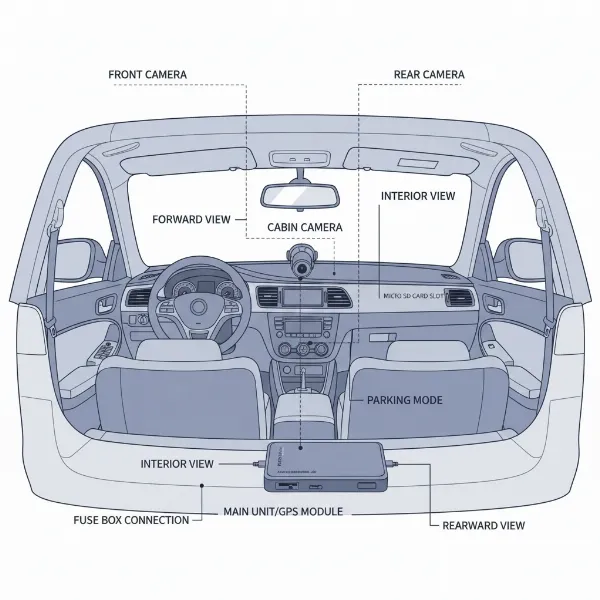 A diagram showing a 3-channel dash cam system with cameras pointing front, rear, and interior of a car, highlighting comprehensive coverage
Choosing the Right Dash Cam for Your Needs: A Practical Guide
Deciding on the perfect dash cam comes down to a few key considerations tailored to your individual circumstances. There’s no one-size-fits-all answer, but by evaluating your driving habits, budget, and desired level of protection, you can narrow down your options effectively.
Key Factors to Consider
-
Your Driving Environment:
- City Commutes: A single channel might suffice for front-facing risks.
- Frequent Highway Driving: Dual channel provides crucial rear-end protection.
- Rideshare/Taxi Driving: A 3-channel system is almost a necessity for passenger and driver safety.
- Parking Location: If you park in busy or high-risk areas, multi-channel parking surveillance is invaluable.
-
Budget:
- Entry-Level (under $100-150): Likely single channel or basic dual channel.
- Mid-Range ($150-300): Good quality dual channel systems.
- Premium ($300+): High-end dual channel or advanced 3-channel systems with superior features.
-
Level of Protection Desired:
- Basic Accident Evidence: Single channel.
- All-Around Road Protection: Dual channel.
- Complete Vehicle & Occupant Surveillance: 3-channel.
-
Installation Comfort:
- DIY Friendly: Single channel is easiest.
- Moderate DIY: Dual channel might be manageable with some effort.
- Professional Recommended: 3-channel due to intricate wiring.
Who Needs Which Type? A Quick Reference
| Dash Cam Type | Best For | Key Benefit |
|---|---|---|
| Single Channel | Daily commuters, budget buyers, first-time users. | Affordable, simple, records the road ahead. |
| Dual Channel | Families, regular drivers, those wanting front and rear collision evidence, enhanced parking monitoring. | Comprehensive front & rear coverage, vital for insurance and peace of mind. |
| 3-Channel | Rideshare/taxi drivers, fleet owners, parents of teen drivers, anyone seeking ultimate 360-degree protection. | Full front, rear, and interior surveillance for maximum accountability. |
Installation and Storage Considerations
While single channel dash cams are generally a breeze to install, often simply plugging into a cigarette lighter socket, dual and 3-channel systems introduce more complexity. The rear camera typically requires routing a cable from the front unit to the back of the vehicle, which can involve tucking wires under trim panels. For 3-channel systems, the interior camera usually integrates with the main unit but still adds to the overall setup.
Storage is another critical factor. More channels mean more video files being recorded simultaneously, which rapidly consumes memory card space. A single channel might be fine with a 32GB or 64GB card, but a 3-channel system will quickly fill that up. Investing in a high-endurance microSD card of 128GB or 256GB is strongly recommended for multi-channel dash cams to ensure continuous, reliable recording without constant overwriting. Many advanced systems also benefit from hardwiring to the car’s fuse box, enabling continuous parking surveillance without draining the car’s main battery.
Conclusion
Choosing between a single, dual, or 3-channel dash cam is a pivotal decision that directly impacts your safety, peace of mind, and the comprehensiveness of evidence available should an incident occur. While a single channel offers basic, budget-friendly front protection, a dual channel significantly enhances safety with front and rear coverage. For those demanding the utmost security and accountability, particularly professional drivers or concerned families, a 3-channel system provides unparalleled 360-degree surveillance.
Consider your daily driving routine, your budget, and the level of protection you genuinely need. By understanding the distinct advantages and disadvantages of each dash cam type, you can confidently select the perfect guardian for your vehicle and ensure a safer, more secure journey every time you hit the road. What type of dash cam best suits your unique driving lifestyle?
Frequently Asked Questions
Do 3-channel dash cams drain more battery than other types?
While 3-channel dash cams utilize more cameras, modern digital cameras are very power-efficient. Most systems also come with intelligent power management and parking modes that activate hibernation to conserve battery, meaning they typically don’t cause excessive battery drain compared to other types. Hardwiring kits are often used to manage power efficiently for continuous parking surveillance.
What kind of SD card storage do I need for a 3-channel dash cam?
A 3-channel dash cam records three video feeds simultaneously, which generates large file sizes. It’s highly recommended to use a high-endurance microSD card with a storage capacity of at least 128GB, and preferably 256GB, to ensure sufficient recording time and reliable performance without frequent overwrites.
Is professional installation necessary for dual or 3-channel dash cams?
For single channel dash cams, DIY installation is straightforward. For dual and especially 3-channel Dash Cams, installation can be more complex due to wiring the rear and interior cameras. While many technically inclined individuals can DIY, professional installation ensures clean cable management, optimal camera positioning, and proper power integration, maximizing the system’s effectiveness and aesthetics.