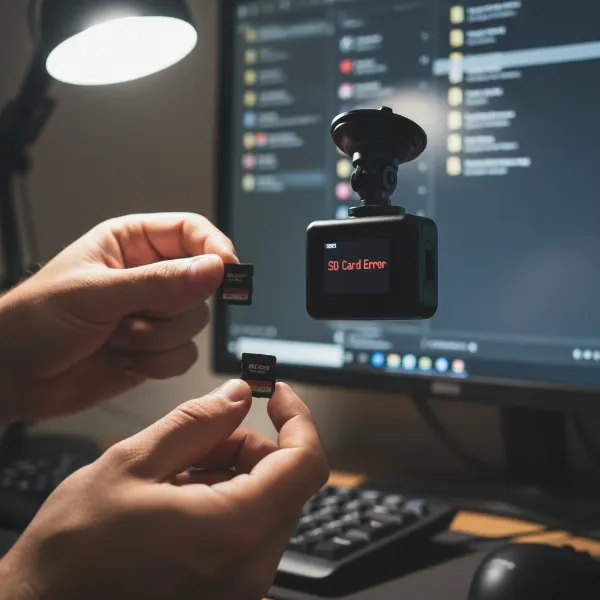
Driving in today’s unpredictable world means having a reliable eyewitness on the road. Your dash cam is that crucial witness, silently recording every moment, but its effectiveness hinges entirely on one often-overlooked component: the microSD card. Many drivers mistakenly use standard memory cards, only to face frustrating failures and discover vital footage missing when they need it most. This comprehensive guide will illuminate the critical differences between high endurance and regular microSD cards, empowering you to choose the right storage solution for uninterrupted recording and peace of mind on every journey.
Understanding Dash Cam SD Cards: More Than Just Storage
A dash cam’s primary function is continuous video recording, capturing your drive in a perpetual loop. This constant process of writing new video, deleting old files, and overwriting existing data places immense strain on its memory card. Unlike a typical camera or smartphone that writes data intermittently, a dash cam’s card operates under a heavy, 24/7 workload. This demanding cycle, coupled with the harsh automotive environment—ranging from freezing winters to scorching summer interiors—creates a perfect storm for premature card failure if you’re not using the right type.
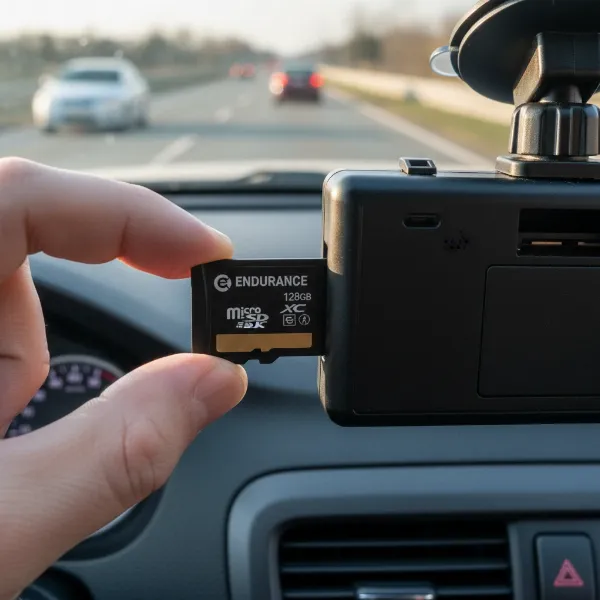 A close-up of a high endurance microSD card being inserted into a dash cam, emphasizing its critical role in recording.
High Endurance SD Cards: Built for the Road Ahead
High endurance microSD cards are specifically engineered to meet the rigorous demands of dash cams and other continuous recording devices like security cameras. The fundamental difference lies in their internal components and design. These cards utilize higher-quality NAND flash memory cells, which can withstand significantly more write cycles before degrading. They also incorporate advanced wear-leveling technology and robust error correction mechanisms. This intelligent design ensures data is distributed evenly across the card, preventing any single sector from wearing out prematurely, and maintaining data integrity even after thousands of overwrites.
Beyond their superior internal architecture, high endurance cards are built to be physically tougher. They are designed to operate reliably in extreme temperatures, typically ranging from -25°C to 85°C. Many are also shockproof, waterproof, and X-ray proof, offering an unparalleled level of durability crucial for the unpredictable conditions inside a vehicle. This specialized construction translates directly into a dramatically longer lifespan, often rated for tens of thousands of hours of continuous recording, far exceeding what a regular card can offer.
Regular MicroSD Cards: Why They Fall Short in a Dash Cam
Conversely, regular microSD cards are designed for consumer devices with intermittent data writing, such as digital cameras for photos or smartphones for apps and occasional video clips. While they may boast impressive read speeds or large capacities, they lack the specialized endurance features necessary for a dash cam’s constant loop recording. Their standard NAND flash memory cells and simpler wear-leveling algorithms are simply not equipped to handle the relentless write-and-overwrite cycles.
When subjected to dash cam use, regular cards quickly degrade. The constant data manipulation causes memory cells to wear out rapidly, leading to a host of problems including corrupted files, dropped frames, intermittent recording failures, and eventually, total card failure. Furthermore, they are often less resilient to extreme temperatures, making them vulnerable to the heat fluctuations common in vehicle interiors. The consequence of using a regular card is often lost footage, rendering your dash cam useless precisely when you need it to capture crucial events. Many dash cam manufacturers even void warranties if standard cards are used, underscoring the critical importance of selecting the correct type.
 A symbolic image depicting a regular microSD card cracking or breaking under pressure, with a blurred, distressed dash cam in the background.
Choosing the Right Dash Cam SD Card: Key Factors
Selecting the optimal microSD card for your dash cam involves understanding several key specifications beyond just capacity. Prioritizing these factors will ensure your dash cam records reliably and captures high-quality evidence when it matters most.
Endurance Rating (TBW/Hours)
|
Our Picks for the Best Dash Cam in 2026
As an Amazon Associate I earn from qualifying purchases.
|
||
| Num | Product | Action |
|---|---|---|
| 1 | ROVE R2-4K DUAL Dash Cam Front and Rear, STARVIS 2 Sensor, FREE 128GB Card Included, 5G WiFi - up to 20MB/s Fastest Download Speed with App, 4K 2160P/FHD Dash Camera for Cars, 3" IPS, 24H Parking Mode |

|
| 2 | Dash Cam Front and Rear, 1080P Dash Camera for Cars, 3 Channel Car Camera Front Rear and Inside with 32GB Card, Loop Recording, Night Vision, HDR, 24Hr Parking, G-Sensor |
|
| 3 | 4K Dash Cam Front, Built-in 5G WiFi, 64GB Card Included, Dash Camera for Cars, Mini Dashcam with Super Night Vision, Loop Recording, G-Sensor, 24 Hours Parking Monitor, Support 256GB Max |
|
| 4 | VIOFO A229 Plus Dash Cam Front and Rear, Dual STARVIS 2 Sensors, 2 Channel HDR, 1440P+1440P Voice Control Car Dash Camera, 5GHz Wi-Fi, Voice Control, Ultra-Precise GPS |
|
| 5 | Dash Cam Front and Rear, 2.5K Dual Dash Camera for Cars, 2560P Mini Car Camera, 2 inch IPS Screen, 32GB Card Included, WDR Night Vision, 24 Hours Parking Monitor, G-Sensor, Support 256 GB Max |
|
| 6 | Dual 4K Dash Cam Front and Rear - Free 64G SD Card, 2160P+2160P UHD Dash Camera for Cars, Dashcam with 176°+160° Wide Angle, 3.5'' IPS Screen Dashcam, G-Sensor, WDR, Night Vision, 24H Parking Monitor |
|
| 7 | Garmin Dash Cam™ Mini 3, Ultracompact 1080p HD Dash Cam with a 140-degree Field of View, Built in Clarity™ Polarizer, Voice Controlled, Automatic Recording |
|
| 8 | WOLFBOX G840S 12" 4K Mirror Dash Cam Backup Camera, 5.8GHz WiFi Smart Rearview Mirror for Cars & Trucks, Front and Rear View Dual Cameras, Night Vision, Parking Assistance, Included 32GB Card & GPS |
|
| 9 | REDTIGER 4K Dash Cam Front Rear, STARVIS 2 Sensor, Free Card Included, 5.8GHz WiFi-20MB/s Fast Download, Dash Camera for Cars with GPS, WDR Night Vision, 170°Wide Angle, 24H Parking Mode(F7NP) |
|
| 10 | 4K+4K Dash Cam Front and Rear, Free 128GB Card Included, 5.8GHz WiFi Dash Camera for Cars, Built-in GPS, G-Sensor, 170°Wide Angle, 3" IPS Screen, 24H Parking Mode, Support 512GB Max |
|
This is perhaps the most critical specification for dash cams. Endurance ratings indicate the total amount of data that can be written to the card over its lifetime, often expressed in Terabytes Written (TBW) or hours of continuous recording. High endurance cards are rated for significantly more write cycles and longer recording times (e.g., 20,000 to over 40,000 hours) compared to standard cards, making them suitable for the dash cam’s constant demands.
Speed Class (UHS, V-Class)
Dash cams require a minimum sustained write speed to prevent dropped frames and ensure smooth video recording, especially with higher resolutions.
- Class 10 (C10): Minimum 10 MB/s write speed, generally sufficient for Full HD (1080p) recording.
- UHS Speed Class 1 (U1): Also 10 MB/s, adequate for Full HD.
- UHS Speed Class 3 (U3): Minimum 30 MB/s write speed, essential for 2K and 4K video recording.
- Video Speed Class (V30, V60, V90): V30 indicates a minimum 30 MB/s write speed, ideal for 4K. V60 and V90 offer even higher speeds for demanding 4K/8K applications. Always match the card’s speed class to your dash cam’s resolution requirements.
Capacity: How Much Do You Need?
The ideal capacity depends on your dash cam’s resolution, the number of channels (front, rear, interior), and how long you want to retain footage before it’s overwritten.
- 32GB: Short recording times (e.g., 2-4 hours for 1080p).
- 64GB – 128GB: The sweet spot for most users, offering 8-16 hours of 1080p or 2-5 hours of 4K footage.
- 256GB – 512GB: Recommended for 4K dash cams, multi-channel setups, or extended parking mode recording, providing up to 10-32 hours of 1080p or 5-10 hours of 4K.
Temperature Tolerance
Look for cards specified with a wide operating temperature range, typically -25°C to 85°C, to withstand the extreme heat and cold inside a parked vehicle. This resilience prevents card malfunctions due to thermal stress.
Reliable Brands
Stick with reputable brands known for manufacturing high-quality, high endurance microSD cards. Leading names include Samsung (Pro Endurance series), SanDisk (High Endurance/Max Endurance series), Lexar, VIOFO (Industrial Grade), and Transcend. These brands often provide better warranties and more consistent performance.
Top High Endurance SD Card Recommendations for Dash Cams
When it comes to safeguarding your journeys, investing in a top-tier high endurance microSD card is paramount. These models stand out for their exceptional reliability and performance under continuous recording conditions.
- Samsung Pro Endurance: Renowned for its superior longevity, with some models offering up to 43,800 hours of continuous recording. It provides robust temperature resilience and consistent write speeds, making it a favorite for critical applications.
- SanDisk High Endurance / Max Endurance: A strong contender, offering up to 40,000 hours of recording (High Endurance) or even 120,000 hours (Max Endurance). These cards deliver reliable performance, capable of handling 4K footage, and are built to withstand harsh environmental factors like extreme temperatures, shocks, and water.
- Lexar High Endurance Series: Offers a cost-effective solution with solid endurance claims and good speed ratings, performing well even with 4K recording in various dash cam models.
- VIOFO Industrial Grade microSD Card: Specifically designed for dash cams and action cameras, these cards emphasize extended endurance and excellent reliability, suitable for harsh conditions with additional waterproof, anti-X-ray, and anti-magnetic properties.
- Transcend High Endurance MLC Cards: Valued for their multi-level cell (MLC) NAND technology, which typically offers better endurance and reliability compared to triple-level cell (TLC) NAND found in many standard cards.
When comparing these, consider your dash cam’s specific resolution, desired recording time, and your budget. While some cards might offer slightly faster write speeds, the overarching priority for dash cam use is endurance and reliability.
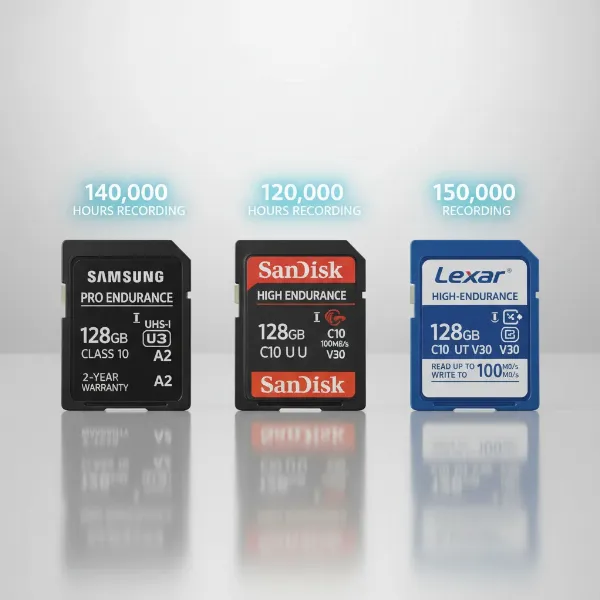 A side-by-side comparison of different high endurance microSD cards, showcasing brand logos and key specifications like endurance hours and speed class.
Maximizing Your Dash Cam SD Card’s Lifespan: Care and Maintenance
Even the best high endurance microSD cards benefit from proper care to ensure their longevity and reliable performance. Think of it as routine maintenance for your digital eyewitness.
The most crucial practice is regular formatting. It is highly recommended to format your microSD card at least once a month. This process completely refreshes the card’s file system, clears out any fragmented or corrupted data, and prepares it for optimal recording. Always perform the format directly within your dash cam’s settings rather than on a computer. This ensures the card is formatted precisely to the dash cam’s specifications, preventing compatibility issues.
Periodically check for firmware updates for your dash cam. Manufacturers often release updates that improve SD card management, enhance recording stability, and address potential compatibility glitches. Finally, be mindful that while high endurance cards last significantly longer, they are still consumables. If you notice persistent issues like error messages, corrupted files, or the dash cam freezing, even after formatting, it might be time to replace the card. Having a spare high endurance card on hand can save you from downtime and missed footage.
Troubleshooting Common SD Card Issues in Dash Cams
Even with a high endurance card, problems can occasionally arise. Recognizing the signs of a failing card and knowing basic troubleshooting steps can prevent critical data loss.
Common indicators of an SD card issue include:
- Frozen Boot Screen or Slow Startup: Your dash cam takes an unusually long time to power on or gets stuck on its startup screen.
- “Memory Card Error” or “Please Format Card” Messages: These explicit warnings from your dash cam signal a problem with the card’s integrity or file system.
- “Card Slow” Warning: Indicates the card isn’t keeping up with the dash cam’s write speed requirements, leading to dropped frames.
- False “Memory Card Full” Alarms: The dash cam claims the card is full even after recent formatting or if its capacity should allow for more recording.
- Corrupted or Missing Files: Video files are unplayable, incomplete, or simply not present when you review footage.
- Formatting Failed: The dash cam cannot successfully format the card.
If you encounter these issues, start by performing a fresh format within the dash cam. If the problem persists, try a different, known-good high endurance card. Sometimes, the issue might stem from the dash cam itself, such as a faulty card slot or outdated firmware. However, more often than not, it’s the card that’s reached its end of life or is simply not suitable for dash cam use.
Conclusion
The humble microSD card is the unsung hero of your dash cam, a critical component that determines whether your device truly delivers on its promise of capturing every moment. Choosing a high endurance microSD card over a regular one is not merely an upgrade; it’s an essential investment in the reliability and trustworthiness of your dash cam system. With their specialized design for continuous writing, resistance to extreme conditions, and significantly longer lifespans, high endurance cards provide the peace of mind you need on today’s roads. Don’t compromise on this vital element—ensure your dash cam is equipped with the best possible storage to protect you and your vehicle.
Are you confident that your dash cam’s memory card is truly up to the challenge?
Frequently Asked Questions
Why do dash cam SD cards fail so often?
Dash cam SD cards fail frequently because they are subjected to constant loop recording, which involves intensive writing, deleting, and rewriting of data. This workload rapidly wears out the memory cells of standard cards that are not designed for such continuous operation.
Can I use a regular microSD card in my dash cam to save money?
While you technically can insert a regular microSD card into a dash cam, it is strongly advised against. Regular cards are not built for the constant write cycles and extreme temperatures, leading to premature failure, corrupted footage, and potentially missing crucial evidence. The cost savings are often outweighed by the risk and inconvenience.
How often should I format my dash cam’s SD card?
It is recommended to format your dash cam’s microSD card at least once a month. This maintenance routine helps maintain the card’s health, prevents data corruption, and ensures optimal performance for continuous recording. Always format the card within your dash cam’s settings.
What speed class do I need for a 4K dash cam?
For a 4K dash cam, you will need a microSD card with a minimum write speed of 30 MB/s. Look for cards rated as UHS Speed Class 3 (U3) or Video Speed Class V30, V60, or V90 to ensure smooth, uninterrupted 4K video recording without dropped frames.
How long do high endurance SD cards typically last in a dash cam?
High endurance SD cards are designed for extended lifespans, typically lasting between 20,000 and over 40,000 hours of continuous recording, depending on the specific model and manufacturer. This translates to several years of reliable performance under normal Dash Cam usage.