Driving in scorching heat can be brutal, not just for you, but for your car’s electronics too. Picture your vehicle sitting under the blazing sun, cabin temperatures soaring well above 60°C (140°F). In such conditions, a reliable dash cam isn’t just a luxury; it’s a necessity. Yet, many drivers face unexpected issues with their dash cams, particularly concerning heat. The core of this problem often lies in their power source: traditional lithium-ion batteries. For unparalleled durability and performance in high temperatures, capacitor-powered dash cams stand out as the superior choice, ensuring your crucial footage is always safe.
Understanding the Core Difference: Capacitors vs. Batteries
At the heart of every dash cam lies its power storage component, determining its reliability and longevity. While both capacitors and batteries store electrical energy, their fundamental mechanisms and performance characteristics, especially under stress, vary significantly.
Battery-powered dash cams typically rely on lithium-ion batteries, similar to those found in smartphones or laptops. These batteries are designed for sustained energy storage, allowing the dash cam to operate for periods without an external power source, such as during a parking mode that requires continuous surveillance. However, their chemical composition makes them sensitive to temperature fluctuations and prolonged charging/discharging cycles.
Capacitor-powered dash cams, on the other hand, utilize supercapacitors. Unlike batteries, supercapacitors are built for rapid charging and discharging, acting more like an energy buffer rather than a long-term storage unit. Their primary role in a dash cam is to provide sufficient power for a safe shutdown and to save the last recorded files when the vehicle’s engine is turned off or if power is suddenly lost. They are not intended to power the camera continuously for extended periods when the car is off. This fundamental difference in their energy storage and release mechanisms is what gives capacitors a distinct edge in challenging environments.
The Unrivaled Heat Resistance of Capacitor Dash Cams
When it comes to enduring extreme heat, capacitor-based dash cams demonstrably outperform their battery-powered counterparts. This is the primary reason why seasoned dash cam users and experts advocate for capacitor models, particularly in regions with hot climates.
The vulnerability of lithium-ion batteries in high temperatures stems from their internal chemistry. As temperatures climb inside a parked car, often exceeding 60°C (140°F) and sometimes even reaching 70°C (158°F), lithium-ion batteries are prone to several critical issues. They can suffer from swelling and leaking, where the battery physically expands and potentially ruptures, releasing corrosive chemicals that can damage the dash cam’s internal components. More alarmingly, these batteries carry a risk of thermal runaway, a dangerous chain reaction that can lead to overheating, combustion, or even explosions. This poses a significant safety hazard not just to the dash cam, but also to the vehicle and its occupants.
Capacitors, in stark contrast, are engineered with a more stable physical structure that is far less susceptible to heat-induced degradation. They are designed to operate reliably in broad temperature ranges, typically performing well in temperatures up to 70°C (158°F) without experiencing the performance drops or safety risks associated with batteries. Their inherent resistance to extreme temperatures means a capacitor-powered dash cam is far less likely to shut down unexpectedly, fail to record critical footage, or suffer permanent damage when exposed to prolonged heat. This stability ensures that your dash cam remains operational and dependable when you need it most, providing consistent performance even on the hottest days.
Beyond Heat: Additional Advantages of Capacitor Dash Cams
While superior heat resistance is the most compelling argument for capacitor dash cams, their benefits extend well beyond hot weather performance, contributing to overall reliability and user experience.
One significant advantage is their extended lifespan and durability. Unlike lithium-ion batteries, which degrade over time with each charge and discharge cycle, capacitors maintain their capacity much longer. They are built to withstand tens of thousands, if not hundreds of thousands, of charge cycles, ensuring your dash cam remains reliable for years without needing frequent replacements due to battery degradation. This translates into a more sustainable and cost-effective solution in the long run.
Furthermore, improved safety is a paramount benefit. The absence of volatile chemicals and the reduced risk of thermal runaway mean capacitor dash cams pose virtually no threat of swelling, leaking, or catching fire, even under direct sunlight. This peace of mind is invaluable for any driver. Capacitors also boast faster charging and discharging capabilities, allowing them to quickly store enough power for a safe shutdown and file saving within seconds of power loss. This swift response minimizes the risk of data corruption or loss, preserving crucial footage immediately after an incident. Their design also contributes to more stable overall performance, as they are less prone to the voltage fluctuations that can sometimes affect battery-powered devices. Lastly, from an environmental perspective, capacitors are generally considered more eco-friendly, involving fewer hazardous materials in their construction and disposal compared to lithium-ion batteries.
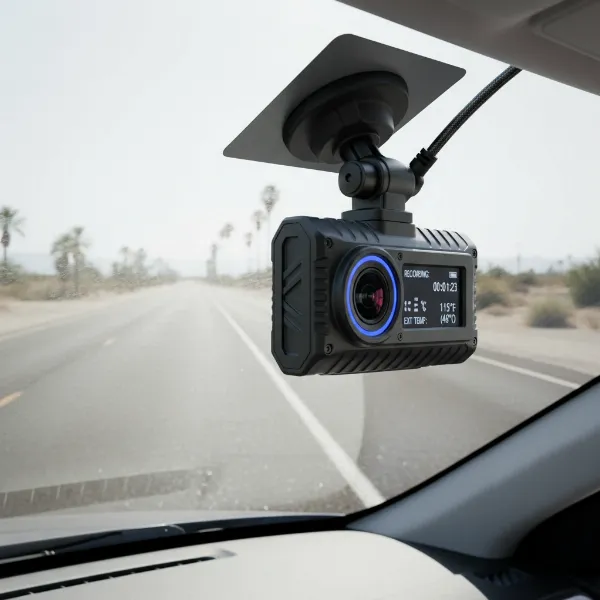 Capacitor dash cam operating reliably in a hot car interior, symbolizing extreme heat resistance
The Downside of Battery-Powered Dash Cams
While battery-powered dash cams might seem appealing due to lower initial costs or the ability to offer short-term parking mode without a direct power connection, their disadvantages, particularly in the context of extreme temperatures, are substantial.
The most critical drawback is their vulnerability to heat. As discussed, hot car interiors can lead to battery swelling, leakage, unexpected shutdowns, and the dangerous potential for thermal runaway. These failures don’t just interrupt recording; they can permanently damage the device and even pose a fire risk. The frequent heating and cooling cycles experienced in a vehicle accelerate the degradation of lithium-ion batteries, significantly shortening their operational lifespan. A battery that once held a charge for minutes might soon only last seconds, or fail entirely, compromising essential features like emergency file saving.
Moreover, in an effort to reduce manufacturing costs, some budget dash cam manufacturers might equip their devices with low-quality lithium-ion batteries. These inferior batteries are even more susceptible to heat-related issues and premature failure, leading to unreliable performance and a frustrating user experience. The promise of an inexpensive dash cam can quickly turn into a costly endeavor if the device fails in critical moments or requires frequent replacement due to battery-related problems.
Choosing the Right Dash Cam for Your Climate
Making an informed decision about your dash cam’s power source is critical for long-term reliability and safety, especially if you live in a warm climate or frequently park your car outdoors under direct sunlight.
For drivers in hot climates, or those whose vehicles are routinely exposed to high internal temperatures, capacitor-based dash cams are the unequivocally recommended choice. Their inherent stability and resilience to heat provide a robust solution that minimizes the risk of failure, damage, or safety hazards. While lithium iron phosphate (LiFePO4) batteries represent a safer alternative to standard lithium-ion, offering improved thermal stability, supercapacitors still generally hold the edge for pure heat resistance and longevity in the most extreme conditions. Consider your typical driving environment and parking habits; if your car is often a sun-baked oven, a capacitor model is an investment in peace of mind.
Maintenance Tips for Longevity
Regardless of whether your dash cam uses a capacitor or a battery, proper care can extend its life and ensure optimal performance. Always ensure the dash cam is mounted securely, ideally in a location that minimizes direct sunlight exposure when parked, if possible. Regularly check for firmware updates, as these can improve stability and add new features. Clean the lens periodically to maintain clear video quality. While capacitor dash cams are more resilient, avoiding extreme temperature fluctuations where possible will always benefit any electronic device.
Conclusion
The choice between a capacitor and battery-powered dash cam is clear when heat resistance, longevity, and safety are paramount. While both serve to power your device, supercapacitors offer a superior solution for the demanding environment of a vehicle’s interior. Their ability to withstand extreme temperatures without swelling, leaking, or posing a fire risk makes them the more reliable and safer option. Opting for a capacitor dash cam ensures your eyewitness on the road remains vigilant and dependable, safeguarding your journeys for years to come. Don’t compromise on reliability; choose a dash cam built to brave the heat. What steps will you take to ensure your dash cam is prepared for the harshest conditions?
Frequently Asked Questions
Why do dash cam batteries swell?
|
Our Picks for the Best Dash Cam in 2026
As an Amazon Associate I earn from qualifying purchases.
|
||
| Num | Product | Action |
|---|---|---|
| 1 | Dual 4K Dash Cam Front and Rear - Free 64G SD Card, 2160P+2160P UHD Dash Camera for Cars, Dashcam with 176°+160° Wide Angle, 3.5'' IPS Screen Dashcam, G-Sensor, WDR, Night Vision, 24H Parking Monitor |

|
| 2 | 4K Dash Cam Front, Built-in 5G WiFi, 64GB Card Included, Dash Camera for Cars, Mini Dashcam with Super Night Vision, Loop Recording, G-Sensor, 24 Hours Parking Monitor, Support 256GB Max |
|
| 3 | REDTIGER 4K Dash Cam Front Rear, STARVIS 2 Sensor, Free Card Included, 5.8GHz WiFi-20MB/s Fast Download, Dash Camera for Cars with GPS, WDR Night Vision, 170°Wide Angle, 24H Parking Mode(F7NP) |
|
| 4 | 4K+4K Dash Cam Front and Rear, Free 128GB Card Included, 5.8GHz WiFi Dash Camera for Cars, Built-in GPS, G-Sensor, 170°Wide Angle, 3" IPS Screen, 24H Parking Mode, Support 512GB Max |
|
| 5 | VIOFO A229 Plus Dash Cam Front and Rear, Dual STARVIS 2 Sensors, 2 Channel HDR, 1440P+1440P Voice Control Car Dash Camera, 5GHz Wi-Fi, Voice Control, Ultra-Precise GPS |
|
| 6 | Dash Cam Front and Rear, 2.5K Dual Dash Camera for Cars, 2560P Mini Car Camera, 2 inch IPS Screen, 32GB Card Included, WDR Night Vision, 24 Hours Parking Monitor, G-Sensor, Support 256 GB Max |
|
| 7 | ROVE R2-4K DUAL Dash Cam Front and Rear, STARVIS 2 Sensor, FREE 128GB Card Included, 5G WiFi - up to 20MB/s Fastest Download Speed with App, 4K 2160P/FHD Dash Camera for Cars, 3" IPS, 24H Parking Mode |
|
| 8 | Garmin Dash Cam™ Mini 3, Ultracompact 1080p HD Dash Cam with a 140-degree Field of View, Built in Clarity™ Polarizer, Voice Controlled, Automatic Recording |
|
| 9 | Dash Cam Front and Rear, 1080P Dash Camera for Cars, 3 Channel Car Camera Front Rear and Inside with 32GB Card, Loop Recording, Night Vision, HDR, 24Hr Parking, G-Sensor |
|
| 10 | WOLFBOX G840S 12" 4K Mirror Dash Cam Backup Camera, 5.8GHz WiFi Smart Rearview Mirror for Cars & Trucks, Front and Rear View Dual Cameras, Night Vision, Parking Assistance, Included 32GB Card & GPS |
|
Dash cam batteries, typically lithium-ion, swell due to gases produced internally when exposed to high temperatures, overcharging, or age. This expansion is a sign of degradation and can lead to leakage or even fire hazards, particularly common in hot car interiors.
Can a capacitor dash cam record without a power source?
No, a capacitor dash cam cannot record continuously without a constant power source. Its capacitor stores enough energy for a few seconds to safely shut down and save the last recorded file upon power loss, but it’s not designed for extended recording while parked without an external power supply.
Are capacitor dash cams more expensive?
Capacitor-based dash cams can sometimes have a slightly higher upfront cost than their battery-powered counterparts. However, their superior durability, longer lifespan, and greater reliability, especially in extreme temperatures, often make them a more cost-effective investment over time by reducing the need for replacements.
What is the ideal operating temperature for a dash cam?
Most dash cams are designed to operate within a certain temperature range. For capacitor-based models, this typically extends to around 70°C (158°F), making them highly suitable for hot environments. Battery-powered dash cams generally have a narrower, lower optimal operating temperature range.
How long do capacitor dash cams last?
Capacitor dash cams generally boast a much longer lifespan than battery Dash Cams, often lasting for many years. This is because capacitors are far more resilient to the repeated charge/discharge cycles and extreme temperature fluctuations that cause traditional batteries to degrade relatively quickly.