Driving after dusk presents a unique set of challenges, from dimly lit roads to the blinding glare of oncoming headlights. In these demanding conditions, a reliable dash cam isn’t just a luxury; it’s a vital safety tool, especially one equipped with superior night vision capabilities. The ability to capture clear, detailed footage in low light can make all the difference when it comes to documenting accidents, identifying perpetrators, or simply ensuring peace of mind on every journey. This article dives deep into the cutting-edge of dash cam technology, highlighting the revolutionary Sony STARVIS 2 sensor and presenting the top 5 dash cams that excel in night vision, ensuring you’re protected 24/7.
Understanding Night Vision in Dash Cams
Dash cams utilize various technologies to “see” in the dark. Fundamentally, they rely on highly sensitive image sensors to capture as much available light as possible. Older or basic dash cams often struggle, producing grainy, underexposed, or overexposed footage that renders critical details, like license plates or facial features, unreadable. For interior or cabin cameras, infrared (IR) LEDs are common, emitting invisible light to illuminate the space, though this typically results in monochrome (black and white) video. However, for capturing the road ahead or behind, ambient light is crucial, and that’s where advanced low-light sensors come into play.
The Power of Sony STARVIS 2: A Deep Dive
Sony’s STARVIS 2 technology represents a significant leap forward in image sensor innovation, setting a new benchmark for low-light video performance in dash cams. Unlike traditional sensors, STARVIS 2 employs a sophisticated back-illuminated pixel structure coupled with a stacked design. This architecture maximizes light intake and optimizes signal processing, allowing the sensor to gather more light and process it efficiently, even in near-zero light conditions.
Key Advantages of STARVIS 2 for Night Vision:
- Exceptional Low-Light Sensitivity: STARVIS 2 sensors can effectively capture light in extremely dark environments, producing clear, often full-color images where older sensors would yield only darkness or heavy noise. This ultra-high sensitivity ensures crucial details are visible.
- Superior High Dynamic Range (HDR) Imaging: A hallmark of STARVIS 2 is its advanced Clear HDR function. This technology synthesizes low-gain and high-gain images simultaneously, preventing common issues like blurred contours or chromatic aberration (ghosting) on fast-moving objects. With an impressive dynamic range, STARVIS 2 expertly balances exposure in high-contrast scenes, such as exiting a tunnel into bright sunlight or dealing with intense oncoming headlights, preserving detail in both bright and dark areas.
- Enhanced Near-Infrared (NIR) Performance: STARVIS 2 significantly improves the absorption rate of near-infrared light, making it approximately 2.5 times more sensitive than its predecessor. This allows for superior imaging under challenging NIR lighting conditions, further boosting its capability in truly dark environments.
- Higher Resolution and Clarity: Many STARVIS 2 sensors, such as the IMX678, boast 4K resolution. Combined with superior light sensitivity and reduced noise, this translates to incredibly sharp and detailed footage, making license plate recognition and identifying other critical elements much more feasible at night.
- Power Efficiency: Thanks to its stacked structure and optimized circuit design, STARVIS 2 consumes approximately 30% less power than conventional models. This is particularly beneficial for dash cams, especially during parking mode recording, where continuous operation needs to be energy-efficient.
The combination of these features means STARVIS 2 sensors deliver clearer, more vibrant images with richer details and significantly improved license plate recognition capabilities, drastically enhancing road safety and providing invaluable evidence.
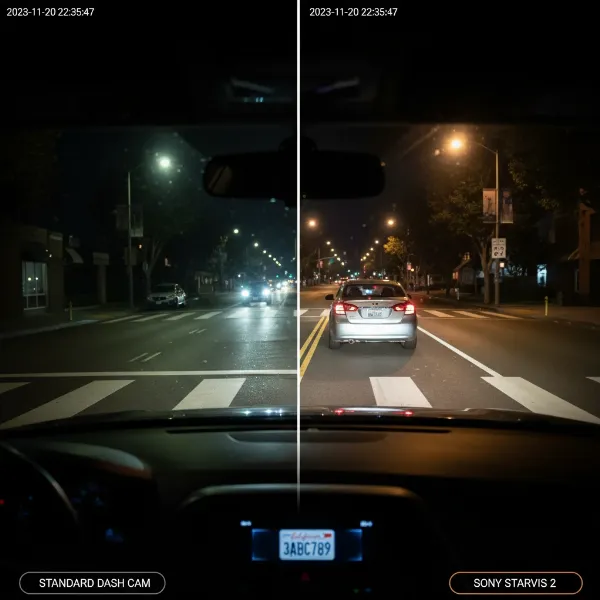 Illustration comparing dash cam footage with and without Sony STARVIS 2 in low light.
Key Factors for Choosing a Night Vision Dash Cam
Selecting the best dash cam for night vision goes beyond just checking for “STARVIS 2.” While critical, other elements contribute to overall low-light performance:
- Image Sensor: Prioritize dash cams explicitly featuring Sony STARVIS 2 sensors (e.g., IMX678, IMX675, IMX662). This is the gold standard for low-light sensitivity.
- Lens Aperture (f-number): Look for a wide aperture, indicated by a smaller f-number (e.g., F1.5 or F1.6). A wider aperture allows more light to reach the sensor, which is crucial for bright night recordings.
- Recording Resolution: Higher resolution (e.g., 4K or 2K) ensures that the captured details are sharp and identifiable, especially when zooming in on footage.
- HDR/WDR Capabilities: These technologies are vital for balancing exposure in varied lighting, preventing overexposure from headlights or underexposure in shadowed areas. STARVIS 2’s Clear HDR is a top-tier example.
- Multi-Channel Options: If you need comprehensive coverage, consider dual (front/rear) or triple-channel (front/cabin/rear) dash cams. Ensure all channels, especially the front and rear, feature strong night vision capabilities.
- Durability and Temperature Resistance: Dash cams operate in extreme conditions. Choose models built to withstand high summer temperatures and cold winters without performance degradation.
Top 5 Dash Cams with Superior Night Vision (STARVIS 2 Powered)
Based on their integration of Sony STARVIS 2 technology, advanced features, and proven low-light performance, these dash cams stand out for superior night vision.
| Dash Cam Model | Primary Sensor | Front Resolution | Key Night Vision Features | Best For |
|---|---|---|---|---|
| VIOFO A229 Pro | Dual Sony STARVIS 2 | 4K (Front) | Clear HDR, high sensitivity, multi-channel | Comprehensive coverage, advanced users |
| Vantrue N4 Pro S | Triple Sony STARVIS 2 | 4K (Front) | 3x STARVIS 2, 3x HDR, waterproof rear cam | Ultimate multi-channel security, cloud |
| VIOFO A119 Mini 2 | Sony STARVIS 2 IMX675 | 2K (QHD) | Compact design, excellent sensitivity | Discreet installation, single-channel focus |
| Wolfbox X5 | Sony STARVIS 2 IMX678 | 4K (Front) | F1.5 aperture, 3-channel, strong overall | All-around performance, cabin monitoring |
| Vantrue S1 Pro | Sony STARVIS 2 IMX675 | 2K (Front) | HDR, slim design, optional LTE module | Balanced features, budget-conscious |
Detailed Review of Top Dash Cams
|
Our Picks for the Best Dash Cam in 2026
As an Amazon Associate I earn from qualifying purchases.
|
||
| Num | Product | Action |
|---|---|---|
| 1 | 4K+4K Dash Cam Front and Rear, Free 128GB Card Included, 5.8GHz WiFi Dash Camera for Cars, Built-in GPS, G-Sensor, 170°Wide Angle, 3" IPS Screen, 24H Parking Mode, Support 512GB Max |

|
| 2 | REDTIGER 4K Dash Cam Front Rear, STARVIS 2 Sensor, Free Card Included, 5.8GHz WiFi-20MB/s Fast Download, Dash Camera for Cars with GPS, WDR Night Vision, 170°Wide Angle, 24H Parking Mode(F7NP) |
|
| 3 | Dash Cam Front and Rear, 2.5K Dual Dash Camera for Cars, 2560P Mini Car Camera, 2 inch IPS Screen, 32GB Card Included, WDR Night Vision, 24 Hours Parking Monitor, G-Sensor, Support 256 GB Max |
|
| 4 | ROVE R2-4K DUAL Dash Cam Front and Rear, STARVIS 2 Sensor, FREE 128GB Card Included, 5G WiFi - up to 20MB/s Fastest Download Speed with App, 4K 2160P/FHD Dash Camera for Cars, 3" IPS, 24H Parking Mode |
|
| 5 | Dual 4K Dash Cam Front and Rear - Free 64G SD Card, 2160P+2160P UHD Dash Camera for Cars, Dashcam with 176°+160° Wide Angle, 3.5'' IPS Screen Dashcam, G-Sensor, WDR, Night Vision, 24H Parking Monitor |
|
| 6 | VIOFO A229 Plus Dash Cam Front and Rear, Dual STARVIS 2 Sensors, 2 Channel HDR, 1440P+1440P Voice Control Car Dash Camera, 5GHz Wi-Fi, Voice Control, Ultra-Precise GPS |
|
| 7 | Garmin Dash Cam™ Mini 3, Ultracompact 1080p HD Dash Cam with a 140-degree Field of View, Built in Clarity™ Polarizer, Voice Controlled, Automatic Recording |
|
| 8 | 4K Dash Cam Front, Built-in 5G WiFi, 64GB Card Included, Dash Camera for Cars, Mini Dashcam with Super Night Vision, Loop Recording, G-Sensor, 24 Hours Parking Monitor, Support 256GB Max |
|
| 9 | Dash Cam Front and Rear, 1080P Dash Camera for Cars, 3 Channel Car Camera Front Rear and Inside with 32GB Card, Loop Recording, Night Vision, HDR, 24Hr Parking, G-Sensor |
|
| 10 | WOLFBOX G840S 12" 4K Mirror Dash Cam Backup Camera, 5.8GHz WiFi Smart Rearview Mirror for Cars & Trucks, Front and Rear View Dual Cameras, Night Vision, Parking Assistance, Included 32GB Card & GPS |
|
1. VIOFO A229 Pro
The VIOFO A229 Pro distinguishes itself with dual Sony STARVIS 2 sensors, offering exceptional night vision across multiple channels. This 2-channel system typically features 4K recording for the front and 2K for the rear, both benefiting from the advanced light-gathering and HDR capabilities of STARVIS 2. Its Clear HDR ensures that transitions from dark to light are smooth, preventing overexposure from headlights while maintaining detail in shadowy areas. This model is ideal for drivers who demand comprehensive, high-resolution coverage with uncompromised low-light performance.
2. Vantrue N4 Pro S
As a leading 3-channel dash cam, the Vantrue N4 Pro S is a powerhouse, boasting three Sony STARVIS 2 sensors and 3x HDR capabilities. It records 4K video for the front, 1080p for the interior, and 1080p for the rear, providing unparalleled coverage. The multiple STARVIS 2 sensors ensure each camera channel delivers superb night vision, crucial for rideshare drivers or those seeking maximum security. Its robust features, including an optional cloud module and waterproof rear cam, make it a top choice for ultimate peace of mind.
3. VIOFO A119 Mini 2
For those seeking a compact yet powerful single-channel dash cam, the VIOFO A119 Mini 2 is an excellent contender. Equipped with the Sony STARVIS 2 IMX675 sensor, it delivers crisp 2K (QHD) resolution with remarkable night vision. Its small wedge shape allows for a discreet installation, making it less noticeable from both inside and outside the vehicle. This dash cam excels in capturing clear license plates and road details in low light, making it a favorite for drivers prioritizing unobtrusive yet effective front-facing recording.
4. Wolfbox X5
The Wolfbox X5 stands out with its 4K front camera featuring the Sony STARVIS 2 IMX678 sensor and an F1.5 aperture, which significantly enhances its low-light recording prowess. This 3-channel dash cam, often including a 1080p cabin camera and a 1944p rear camera, provides strong all-around performance. Its night vision capabilities ensure that recordings are bright and clear, capturing critical information even on poorly lit streets. The Wolfbox X5 is well-suited for drivers who need robust multi-channel monitoring with excellent night-time clarity.
5. Vantrue S1 Pro
The Vantrue S1 Pro offers a compelling balance of features and value, making it an accessible option for superior night vision. It utilizes the Sony STARVIS 2 IMX675 sensor for its 2K front camera, ensuring clear and detailed footage in low-light conditions, complemented by a 1080p rear camera. Its slim design allows for easy integration into your vehicle’s interior. With HDR and an optional LTE module for remote features, the S1 Pro delivers reliable night-time security without breaking the bank, catering to budget-conscious users who don’t want to compromise on critical performance.
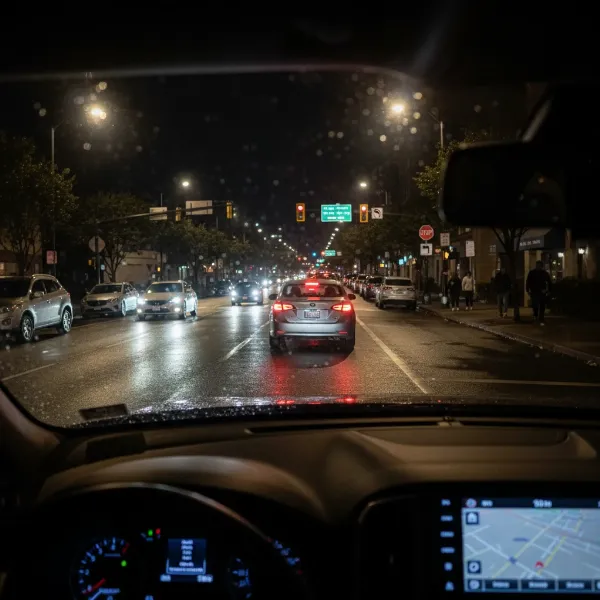 Clear night vision dash cam footage showing a car driving on a road.
Installation and Maintenance Tips for Optimal Night Vision
To maximize your dash cam’s night vision performance, proper installation and routine maintenance are crucial:
- Optimal Placement: Mount your dash cam high on the windshield, preferably behind the rearview mirror, to ensure an unobstructed view of the road. Avoid areas blocked by wipers or tint strips. For interior cameras, ensure the lens has a clear line of sight to the cabin.
- Keep Lenses Clean: Dust, dirt, and smudges on the lens can significantly degrade video quality, especially at night. Regularly clean the camera lens and the section of the windshield it records through with a microfiber cloth.
- Hardwiring for Parking Mode: For continuous 24/7 protection with parking surveillance, hardwiring your dash cam to your vehicle’s fuse box is essential. This ensures the camera receives constant power even when the ignition is off, allowing night vision features to monitor your parked vehicle.
- Regular Firmware Updates: Manufacturers often release firmware updates that improve image processing, including night vision algorithms. Always keep your dash cam’s firmware updated to ensure optimal performance.
- Avoid Internal Reflections: Position the dash cam to minimize reflections from the dashboard or internal lights, which can cause glare and obscure the nighttime view.
“The advancement in image sensor technology, particularly with Sony STARVIS 2, has truly transformed what’s possible in dash cam night vision. It’s no longer just about seeing something in the dark, but capturing verifiable, high-quality evidence.” – Dashcamon.com Admin, Dash Cam Expert
Conclusion
The evolution of dash cam technology, spearheaded by innovations like the Sony STARVIS 2 sensor, has ushered in a new era of night vision capabilities. For drivers navigating the complexities of modern roads, especially after dark, investing in a dash cam with superior low-light performance is a smart decision for both safety and security. The models highlighted above, armed with STARVIS 2 technology, offer unparalleled clarity and detail when it matters most. By understanding these advancements and making an informed choice, you can ensure your journeys are always recorded with crystal-clear precision, day or night.
What aspects of dash cam night vision are most important to you for your daily commute?
Frequently Asked Questions
What makes Sony STARVIS 2 better than standard dash cam sensors for night vision?
Sony STARVIS 2 utilizes a back-illuminated pixel structure and advanced Clear HDR technology, allowing it to capture significantly more light and balance exposure in high-contrast scenes. This results in clearer, more detailed, and often full-color footage in extremely low-light conditions compared to standard sensors that produce noisy or underexposed video.
Can a dash cam with night vision see in complete darkness?
Dash cams with advanced low-light sensors like Sony STARVIS 2 can perform exceptionally well in very dim conditions, often producing color images. However, in absolute pitch black without any ambient light (like deep in a rural area), they will still rely on minimal light sources or switch to a monochrome image if equipped with infrared (IR) LEDs for cabin monitoring.
Is 4K resolution necessary for good night vision?
While 4K resolution provides excellent detail, it’s the combination of a high-quality sensor (like STARVIS 2) and a wide aperture lens that truly defines superior night vision. A 4K sensor without strong low-light capabilities might still produce grainy footage at night. However, a STARVIS 2 sensor at 4K resolution offers the best chance for capturing critical details clearly in the dark.
How does HDR (High Dynamic Range) improve night vision footage?
HDR (or WDR) in dash cams works by combining multiple exposures to create a single, balanced image. This prevents bright areas (like headlights or streetlights) from becoming overexposed and washing out details, while simultaneously ensuring dark areas remain visible and not underexposed. This is vital for maintaining clarity across varied lighting conditions at night.
Do all dash cams with “night vision” have Sony STARVIS 2?
No, many Dash Cams claim “night vision,” but the quality varies significantly. While some might use older STARVIS generations or other low-light sensors, Sony STARVIS 2 represents the current pinnacle of image sensor technology specifically optimized for challenging low-light environments. Always check the sensor specifications if night vision is a priority.